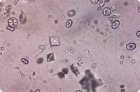
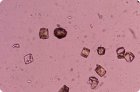
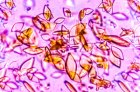
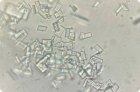
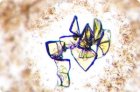
Uric acid crystals in urine are not a disease in themselves, but a laboratory finding that indicates that urine is so oversaturated with uric acid that it begins to precipitate.
In laboratory practice, the words "urate crystals" most often mean crystals of uric acid and its salts, including amorphous urates and some other urate forms.
Phosphate crystals in urine are not an independent disease, but a laboratory finding that is detected during microscopic examination of urinary sediment.
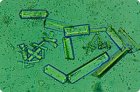
Triple phosphate crystals in urine are crystals of magnesium, ammonium, and phosphate. In modern literature, they are commonly referred to as struvite crystals.
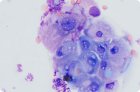
In clinical practice, the term "bladder cytology" usually refers to a cytological examination of urine or bladder washings, which involves looking under a microscope for atypical cells of the urothelium, that is, the lining of the urinary tract.
Crystals in a child's urine are not an independent diagnosis, but a laboratory finding that shows that certain dissolved substances have precipitated in the urine.
In everyday speech, the term "vaginal cytology" is often used as a general term for a Pap test, although in the strict medical sense they are not always the same thing.