
Medical expert of the article

New publications
Voiding cystourethrography: what it shows, when it is needed and how it is performed
Last updated: 06.04.2026

All iLive content is medically reviewed or fact checked to ensure as much factual accuracy as possible.
We have strict sourcing guidelines and only link to reputable media sites, academic research institutions and, whenever possible, medically peer reviewed studies. Note that the numbers in parentheses ([1], [2], etc.) are clickable links to these studies.
If you feel that any of our content is inaccurate, out-of-date, or otherwise questionable, please select it and press Ctrl + Enter.
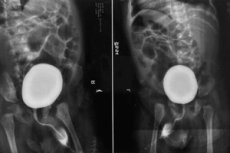
Voiding cystourethrography (VCUG) is an X-ray examination of the bladder and lower urinary tract, performed under fluoroscopy after the bladder is filled with a contrast agent through a catheter. The main difference between this method and a standard X-ray is that the physician can see not only the anatomy but also the process of filling and emptying the bladder, thereby assessing the urinary tract in motion. [1]
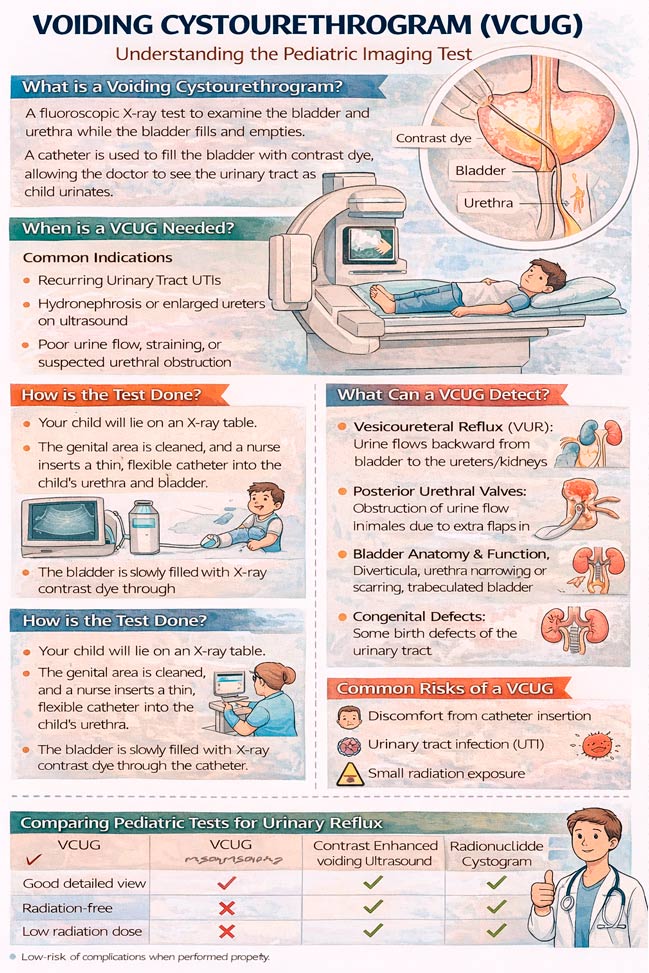
The classic and most common diagnostic task in children is to detect vesicoureteral reflux, that is, the backflow of urine from the bladder into the ureters and sometimes into the renal pelvis. This is why this method is particularly important not as a "test after any urinary tract infection," but as a targeted tool for confirming or ruling out reflux when it will actually impact treatment and follow-up. [2]
But voiding cystourethrography (VCUG) is useful for more than just reflux. Because it simultaneously images the bladder, bladder neck, and urethra during urination, it helps identify posterior urethral valves, bladder outlet obstruction, diverticula, signs of neurogenic bladder, coarse trabecular wall structure, some congenital anomalies, and some postoperative changes. Recent reviews have specifically emphasized that this method is traditionally associated with reflux, but its diagnostic value is much broader. [3]
In adults, this test is prescribed significantly less frequently than in children, and its role is usually more limited. Adult voiding cystourethrography is more often used as part of a urethral assessment following trauma, stricture, diverticulum, or reconstructive procedures, often in conjunction with retrograde urethrography, as this combination better depicts the posterior urethra and complex post-traumatic defects. [4]
Essentially, voiding cystourethrography (VCUG) answers three key clinical questions: Is there upward urinary reflux? Does the lower urinary tract appear and function normally during urination? Is there an anatomical cause that requires observation, infection prevention, endoscopic intervention, or surgery? This is why this test remains so important, despite advances in ultrasound, magnetic resonance imaging, and other techniques. [5]
Below is a brief table showing the information this method provides in practice. Sources: RadiologyInfo, the 2024 European Society of Pediatric Radiology review, and a review of the spectrum of findings on voiding cystourethrography. [6]
| What is being assessed? | What can be identified |
|---|---|
| Filling the bladder | Bladder shape, diverticula, trabeculation, capacity |
| Urination | Coordination of emptying, urethral patency |
| Backflow of urine | Vesicoureteral reflux |
| Urethra | Posterior urethral valves, strictures, traumatic defects |
| Lower urinary tract in general | Congenital and acquired anomalies, consequences of operations |
When is a test really necessary, and when is it prescribed less frequently today?
Modern pediatric practice has moved away from the old paradigm of performing voiding cystourethrography (VCUG) on almost all children after their first episode of febrile urinary tract infection. Today, most guidelines use a more selective approach: the test is prescribed to children whose results can truly change management, rather than as an automatic next step after every episode of cystitis or pyelonephritis. [7]
NICE demonstrates one of the most conservative modern approaches. In its 2022 guidelines, voiding cystourethrography is not routinely recommended for most children over 6 months of age following a typical infection that has responded well to treatment. For certain age groups, NICE suggests considering it only in the presence of certain risk factors, such as urinary tract dilation on ultrasound, poor voiding, infection not caused by E. coli, or a family history of vesicoureteral reflux. [8]
The American College of Radiology takes a slightly broader and more detailed approach to indications based on age-specific scenarios. The 2024 appropriateness criteria emphasize that voiding cystourethrography may be more appropriate after the first febrile episode of infection in infants younger than 2 months than in older children, and in children 2 months and older, the decision is based on ultrasound, recurrences, atypical presentation, and suspicion of obstruction or significant reflux. [9]
There is also a group of patients for whom the method remains particularly valuable. These include children with recurrent febrile urinary tract infections, dilated renal pelvis or ureters on ultrasound, suspected posterior urethral valves, severe voiding dysfunction, congenital urinary tract dilation, as well as patients following some urological surgeries and reconstructions. In these scenarios, voiding cystourethrography continues to play a key role in treatment selection. [10]
Adult urology deserves special consideration. Here, the method is not a screening test and is used in more specific situations: traumatic injury to the posterior urethra, complex strictures, urethral diverticula, and before and after reconstructive surgeries. In other words, in children, voiding cystourethrography more often answers questions about reflux and congenital anomalies, while in adults, it addresses questions about the anatomy and function of the urethra in more complex pathologies. [11]
Below is a table showing when testing is most often justified, and when routine testing appears excessive. Sources: NICE 2022, ACR Appropriateness Criteria 2024, and recent paediatric reviews. [12]
| Situation | The role of voiding cystourethrography |
|---|---|
| The first typical episode of febrile infection in most children over 6 months of age | Usually not routine |
| Recurrent febrile urinary tract infection | Often appropriate |
| Atypical urinary tract infection | Often considered |
| Poor urinary flow, suspected posterior urethral valves | Very important |
| Urinary tract dilation on ultrasound | Often appropriate |
| Suspected vesicoureteral reflux | Basic method of confirmation and gradation |
| Trauma or complex urethral stricture in adults | Used as a special study |
How to prepare for the study and how it is carried out
Preparation for a voiding cystourethrography (VCUG) is usually simpler than many parents expect. According to RadiologyInfo, the child typically does not need to fast, special clothing is not required, and sedation is rarely needed. Much more important is psychological preparation and a calm explanation of what will happen, as the fear of the catheter and the unfamiliar procedure is often worse than the fluoroscopy itself. [13]
There's an important practical detail: the examination is avoided during an active febrile urinary tract infection. RadiologyInfo specifically states that the child should be fever-free on the day of the examination, and the course of antibiotics for the infection should be completed. This is logical both from a clinical perspective and from the standpoint of reducing the risk of additional discomfort and misinterpretation of the results. [14]
The procedure itself begins with catheterization of the bladder through the urethra. After treating the external genitalia, the specialist inserts a thin catheter, secures it, and gradually fills the bladder with a water-soluble contrast agent. Then, under fluoroscopic guidance, images are taken during filling and urination, and once complete, the catheter is removed. According to RadiologyInfo, the entire test typically takes about 30 minutes. [15]
The most uncomfortable part for most children is catheterization and the sensation of a full bladder. However, the procedure itself is not considered traumatic, and severe pain is uncommon. RadiologyInfo notes that the antiseptic may feel cold, and catheter insertion and bladder filling may cause brief discomfort, but the procedure should not cause harm. [16]
Parents should also be aware of another important detail: in the X-ray room, an accompanying adult is often allowed to remain with the child if they wear a protective apron. This isn't just a logistical detail, but a real way to reduce fear and increase cooperation, especially at an age when explanations of the procedure are still limited. [17]
Below is a practical table outlining the steps of the procedure. Sources: RadiologyInfo and standard requirements for pediatric voiding cystourethrography. [18]
| Stage | What's happening |
|---|---|
| Before the study | They check complaints, absence of fever, allergies, medications |
| Preparation | The child is changed and the procedure is explained. |
| Catheterization | A thin catheter is passed into the bladder through the urethra |
| Filling the bladder with contrast | The bladder is gradually filled under fluoroscopy control. |
| Urination | Obtain images during bladder emptying |
| Conclusion | The catheter is removed and the doctor checks that the images are sufficient. |
What the study shows and how to read the results
The most common finding on voiding cystourethrography is vesicoureteral reflux. Normally, urine should not flow back up from the bladder. If the contrast rises into the ureters and beyond, this is reflux. The National Institute of Diabetes and Digestive and Kidney Diseases notes that reflux is graded into 5 degrees, with grade 1 being the mildest and grade 5 being the most severe. [19]
From a practical standpoint, grading is needed not for the sake of a pretty number in the conclusion, but for prognosis and the choice of tactics. The MSD table describes the grades as follows: at grade 1, the contrast reaches only the ureter; at grade 2, it reaches the renal pelvis without dilation of the calyces; at grade 3, dilation of the ureter and pelvis appears with minimal changes in the calyces; at grade 4, dilation increases and the sharp angles of the calyces are smoothed out; and at grade 5, dilation becomes coarse and pronounced. This helps the physician assess the potential clinical significance of reflux. [20]
But the value of the study isn't limited to reflux. Voiding cystourethrography often provides crucial information about the urethra and bladder itself. It can detect posterior urethral valves in boys, bladder wall trabeculations, diverticula, signs of bladder outlet obstruction, incomplete voiding, sometimes severe signs of voiding dysfunction, and some congenital anomalies. It is this simultaneous assessment of the bladder and urethra that makes the method indispensable in a number of pediatric urological scenarios. [21]
It's also important to remember the limits of accuracy. Even the generally accepted international reflux grading system isn't perfectly reproducible, especially for moderate degrees. Studies on assessment reliability have shown that for intermediate degrees, discrepancies between physicians are more common than for clearly mild or clearly severe cases. This isn't a reason to distrust the study, but rather a reason to consider the findings in a clinical context and, if necessary, revise the images. [22]
Another important detail is that the mere discovery of reflux does not necessarily necessitate surgery. Classic and modern studies on reflux show that the prognosis depends not only on the severity of reflux, but also on age, recurrent infections, kidney condition, the presence of scarring, and bladder and bowel dysfunction. Therefore, voiding cystourethrography is a very important, but not the only, factor in the clinical decision. [23]
Below is a table to make typical results easier to read. Sources: NIDDK, MSD Reflux Grade Chart, and AJR Expert Panel 2024 Review. [24]
| Find | What does it usually mean? |
|---|---|
| Reflux grade 1 | Reflux only into the ureter |
| Reflux grade 2 | Throwing to the renal pelvis without expansion of the cups |
| Reflux grade 3 | There is already a moderate expansion |
| Reflux grade 4 | More pronounced expansion and deformation of the cups |
| Reflux grade 5 | Gross dilation and severe anatomical distortion |
| Posterior urethral valves | Lower urinary tract obstruction in boys |
| Trabecular bladder and diverticula | Chronic congestion or impaired emptying |
Limitations, risks and modern alternatives
The main drawback of voiding cystourethrography is the radiation exposure, as it is an X-ray examination. However, the dose involved is small, and modern low-dose protocols allow for further reduction without significant loss of diagnostic quality. RadiologyInfo explicitly notes the low dose of ionizing radiation, and a 2016 study showed that with modern equipment, the dose can be significantly reduced while maintaining acceptable image quality. [25]
The second risk is discomfort and a small chance of infection after catheterization. A recent 2024 pediatric cohort found a 7-day incidence of febrile urinary tract infection after the procedure of approximately 3.8 percent. This is low, but that's why researchers avoid performing the study during active infection and adhere to strict catheterization guidelines. [26]
The third limitation is not related to harm, but to patient selection. If the test is administered too broadly, it will yield many findings that will not change treatment. This is why modern guidelines increasingly recommend a selective approach: first assessing clinical findings and ultrasound, and only then deciding whether voiding cystourethrography is truly necessary. This is one of the most important changes in pediatric urology and pediatrics in recent years. [27]
There are also modern alternatives to this method. Contrast-enhanced voiding urosonography, according to the 2024 European Society of Paediatric Radiology, along with voiding cystourethrography, remains the gold standard for diagnosing vesicoureteral reflux. It does not use ionizing radiation and has become significantly more informative compared to earlier versions. Radionuclide cystography can also detect reflux and delivers a lower gonadal dose, but its anatomical detailing is generally poorer than that of fluoroscopy. [28]
Therefore, the role of voiding cystourethrography today can be summarized as follows: it is not a "universal test for every occasion," but an accurate and still highly valuable method when it is necessary to simultaneously visualize reflux, the bladder, and the urethra during urination. Where the key question is limited to confirming reflux and a modern ultrasound alternative is available, the choice may shift. Where a high-quality assessment of the urethra and lower urinary tract is required, fluoroscopy retains a strong position. [29]
Below is a summary comparison table of the strengths and limitations of the study. Sources: RadiologyInfo, European Society of Paediatric Radiology 2024, and comparative reviews of reflux diagnostic methods. [30]
| Question | Voiding cystourethrography |
|---|---|
| Radiation exposure | There are, but usually small |
| Urethral assessment | Very good |
| Bladder assessment during urination | Very good |
| Diagnosis of vesicoureteral reflux | Basic method |
| Catheterization | Needed |
| Discomfort | Possible, most often due to the catheter and filling of the bladder |
| An alternative without ionizing radiation | Contrast-enhanced voiding urosonography |
| An alternative with low radiation dose but less anatomical detail | Radionuclide cystography |
FAQ
Are voiding cystourethrography (VCUG) and conventional ultrasound the same thing?
No. Ultrasound is a good image of the kidneys and bladder, but it does not replace a dynamic assessment of voiding and does not provide the same direct picture of vesicoureteral reflux and the urethra as VCUG. [31]
Is this test performed on all children after their first urinary tract infection?
No. Current guidelines use a selective approach. Most children do not require routine testing after their first typical episode of infection unless there are warning signs, recurrences, or abnormal ultrasound findings. [32]
How painful is it?
Typically, the main discomfort is associated with the insertion of the catheter and filling the bladder. The procedure can be frightening for the child and cause short-term discomfort, but is not considered traumatic or long-term painful. [33]
Is anesthesia or sedation necessary?
In most cases, no. According to RadiologyInfo, sedation is rarely required. [34]
Is the X-ray examination dangerous?
There is radiation exposure, but it's usually minimal, and modern low-dose protocols further reduce it. A doctor will prescribe the examination when the expected benefit outweighs the risk. [35]
What are the most common findings on examination?
Vesicoureteral reflux is most often sought, but posterior urethral valves, bladder anomalies, diverticula, signs of voiding dysfunction, and some postoperative changes are also identified. [36]
Key points from experts
Maria Beatrice Damasio, MD, Director of Pediatric Radiology at the Istituto Giannina Gaslini in Genoa, Italy.
As Director of Pediatric Radiology and lead author of the European Society of Pediatric Radiology's updated document on voiding cystourethrography, she emphasizes the key rule of thumb: the test remains valuable, but its power is realized when it is ordered for the right indications and performed in a standardized format. [37]
Samuel Stafrace, associate professor of radiology and pediatric radiologist at McMaster University and McMaster Children's Hospital, Canada, says
his work in international pediatric radiology and his involvement in updating guidelines for pediatric urinary tract imaging highlight a second important point: modern voiding cystourethrography (VCUG) is not an outdated test, but a method that should be integrated into a broader strategy for choosing between fluoroscopy, ultrasound, and other modalities for assessing reflux and the urethra. [38]
Tushar Chandra, MD, a pediatric radiologist at Nemours Children's Health, is a co-author of the ACR Appropriateness Criteria for Urinary Tract Infection in Children.
His contribution to the American College of Radiology's appropriateness criteria reflects the current clinical approach: voiding cystourethrography is not needed "out of habit," but rather when it helps identify children at significant risk for reflux, obstruction, and renal scarring. [39]