
Medical expert of the article

New publications
Tattoos for psoriasis: Is it possible, what are the risks, and how to avoid flare-ups?
Last updated: 04.04.2026

All iLive content is medically reviewed or fact checked to ensure as much factual accuracy as possible.
We have strict sourcing guidelines and only link to reputable media sites, academic research institutions and, whenever possible, medically peer reviewed studies. Note that the numbers in parentheses ([1], [2], etc.) are clickable links to these studies.
If you feel that any of our content is inaccurate, out-of-date, or otherwise questionable, please select it and press Ctrl + Enter.

Tattooing with psoriasis isn't an absolute no-no, but it's also not a skin-friendly procedure. The latest European patient information leaflet from 2025 explicitly states that living with psoriasis doesn't preclude tattooing, but active psoriasis, the Koebner phenomenon, local infection, delayed healing, and allergic reactions remain real risks. [1]
The most important thing in this matter is that the decision is not based on the principle of "everyone can" or "nobody can," but rather on the current state of the disease. If psoriasis is active, there are fresh plaques, the skin is irritated, or significant systemic therapy is underway, the decision should almost always be postponed and discussed with a dermatologist. If the disease is calm, the area is clean, and the risks are clear, a tattoo can be considered, but only as a conscious decision, not as a household cosmetic detail. [2]
The current evidence base on this topic is limited primarily to surveys, case series, reviews, and expert opinions, rather than large prospective studies. Therefore, an honest medical approach is especially important here: promising complete safety is impossible, but declaring tattoos categorically prohibited for all patients with psoriasis is also incorrect. [3]
Short answer: When is a tattoo acceptable for psoriasis and when is it not?
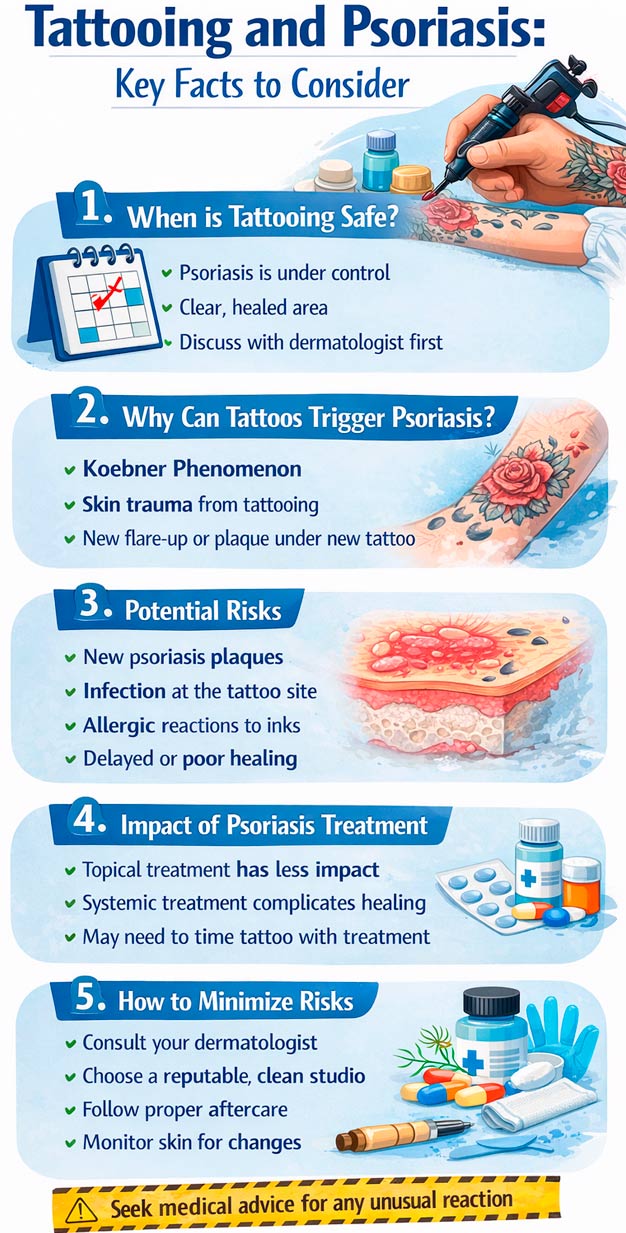
If you're looking for the shortest yet most accurate answer, it's this: getting a tattoo with psoriasis is only possible when the disease is under control, the skin area is free of active plaques, and the patient understands the risk of new lesions developing in the area being tattooed. The European Academy of Dermatology and Venereology states in its guidance that psoriasis itself doesn't preclude a person from getting a tattoo, but the timing and location are crucial. [4]
Tattooing is not recommended for active psoriasis. The same European guidelines explicitly state that active psoriasis requires treatment and stabilization of the skin, and that tattooing an area with an active plaque is prohibited. This is not a formality, but a practical risk-reducing measure, as needlestick injury during unstable inflammation increases the likelihood of new plaques appearing in a freshly applied area. [5]
An additional problem is that psoriasis is a condition that can respond to skin irritation with a new flare-up. The American Academy of Dermatology emphasizes that even with treatment, anything that irritates the skin can trigger a flare-up, and its disease management advice specifically includes avoiding skin injury. A tattoo is essentially a controlled, but still a traumatic, injury to the skin. [6]
Those who have previously experienced the Koebner phenomenon following scratches, scars, bites, surgeries, or other skin injuries should be especially cautious. A Finnish series of patients and reviews of the Koebner phenomenon indicate that this particular history increases the likelihood of a recurrence to new trauma, including tattooing. In other words, if the skin has already responded to injury with psoriasis, a new tattoo will not be a "clean slate." [7]
However, a tattoo does not automatically predict a flare-up in every patient. In a Polish survey of 150 tattooed patients with psoriasis, 8.7% reported complications, and the Koebner phenomenon within the tattoo was 5.3%. In a Finnish series, the rates were higher: 27.6% reported psoriasis on tattoos, and less than 7% reported flare-ups on other body areas. This variability does not indicate chaos, but rather that the risk is highly dependent on patient selection, disease activity, treatment, and data collection method. [8]
| Situation | Practical assessment |
|---|---|
| Psoriasis is active, there are fresh plaques | It's better to postpone the tattoo |
| Area with active plaque | Tattoos are not allowed |
| The disease is under control, the area is clean | The issue can be discussed individually. |
| There was the Koebner phenomenon in the past. | The risk is higher, special care is needed |
| There is systemic therapy | The decision must be made together with a dermatologist. |
Sources for the table: [9]
Why can a tattoo trigger a psoriatic plaque?
The key mechanism here is called the Koebner phenomenon. This is the appearance of new lesions on previously unaffected skin following injury. This is a classic phenomenon for psoriasis: the skin is damaged, the local immune response is altered, and a typical psoriatic plaque can form at the site of injury. Tattooing creates multiple repeated punctures in the skin, so it has long been considered a potential trigger for this reaction. [10]
According to reviews, the Koebner phenomenon occurs in approximately 25% to 30% of people with psoriasis after various types of trauma, although the susceptibility of a particular patient to this reaction may vary over time. This is an important detail: the presence of psoriasis does not necessarily mean a reaction to a tattoo, but the likelihood does exist in some patients and is well known to dermatologists. [11]
The timing of this reaction also varies. In clinical publications, the typical interval between skin damage and the appearance of new lesions is approximately 10 to 20 days, but literature describes variations from 3 days to 2 years, and a leaflet from the European Academy of Dermatology and Venereology specifically emphasizes that psoriasis can reappear in the same tattooed area even years later. This means that the absence of problems in the first few weeks does not guarantee a lifetime cure. [12]
A tattoo can trigger not only a localized plaque within the design but sometimes a more widespread flare-up. The literature contains descriptions of the generalized appearance of psoriatic lesions after tattooing, and a Polish survey documented cases of both a localized Koebner phenomenon and a generalized flare-up. This is not the most common scenario, but it cannot be ignored, especially if the disease is currently unstable. [13]
However, the mere appearance of a plaque on a tattoo does not mean that the pigment will be immediately and irreversibly lost. The European guideline reminds us that psoriasis primarily affects the epidermis, while tattoo pigment is located deeper, in the dermis. Therefore, after the inflammation subsides, the design often remains, although repeated relapses in the same area can significantly deteriorate the appearance and quality of healing. [14]
| What's happening | What does this mean for the patient? |
|---|---|
| The needle repeatedly injures the skin | A local inflammatory response is triggered |
| Some patients experience the Koebner phenomenon | New plaques may appear at the site of the tattoo. |
| The reaction may not occur immediately. | Control is needed not only in the first days |
| Sometimes there is not only a local outbreak, but also a general outbreak. | The risk is not limited to the outline of the drawing |
| The pigment is located deeper than the psoriatic plaque | Treating the plaque won't necessarily remove the tattoo. |
Sources for the table: [15]
The main risks are not only exacerbation, but also infection, allergy, and poor healing.
The most specific risk for psoriasis is the appearance of a new plaque on a tattoo. In a Polish survey, this was the most common complication, and in a Finnish series, many patients reported psoriasis in tattooed areas at varying times. Therefore, the main mistake is to reduce the problem to the beauty of the tattoo. In reality, we are dealing with a real inflammatory response in the skin, which may then require comprehensive treatment. [16]
The second major risk group is not unique to psoriasis, but becomes especially significant given the compromised skin barrier and treatment. The U.S. Food and Drug Administration warns that infections can be associated not only with unsterile instruments but also with the paint itself if it is contaminated with bacteria, mold, or other microorganisms. The U.S. Centers for Disease Control and Prevention has described outbreaks of non-tuberculous mycobacterial infections, including cases associated with pre-diluted gray paint and the use of unsterile water. [17]
A systematic review of bacterial infections following tattoos found that both local skin infections and severe complications, including bacteremia, endocarditis, septic shock, and hospitalization, were described. The review authors emphasize that the risk increases with poor hygiene, improper handling, and contaminated ink. In published reviews, the incidence of infectious complications following tattooing ranged from approximately 0.5% to 6% across different samples. This is especially important for patients with psoriasis who are receiving systemic therapy. [18]
The third risk group includes allergic and chronic inflammatory reactions to the pigment or skin care products. The European leaflet lists contact eczema from skin care products, itchy nodules associated with an allergy to a specific pigment, and granulomas and chronic inflammatory reactions, most commonly associated with black tattoos. The US Food and Drug Administration specifically warns that rashes, persistent redness, bumps, and non-healing inflammation may be signs of an allergic reaction, and that due to the persistent presence of the pigment, the problem can sometimes persist for a long time. [19]
Finally, there are more "quiet" but very unpleasant complications: delayed healing, an unsightly halo due to pigment diffusion, chronic irritation, and simple regret about the tattoo. European guidelines remind that complete tattoo removal is not guaranteed, and laser removal can also be accompanied by scarring. Therefore, for a patient with psoriasis, the tattoo question is not only "will I be able to tolerate the session" but also "am I prepared for the fact that the design may behave unpredictably for years to come." [20]
| Risk | How important is it for psoriasis? |
|---|---|
| Koebner phenomenon | Main specific risk |
| Generalized outbreak | Less common, but possible |
| Bacterial infection | It is especially important in cases of poor hygiene and during systemic treatment. |
| Allergy to pigment and care products | May masquerade as "poor healing" |
| Slow healing and poor aesthetic results | The real reason for disappointment even without infection |
Sources for the table: [21]
How psoriasis treatment changes tattoo decisions
If psoriasis is controlled solely by topical therapy and the target area is free of active lesions, the situation is usually simpler than with moderate or severe disease requiring systemic medications. However, even in this case, the basic logic remains the same: tattooing is only considered on clean, stable skin, not on an area with ongoing inflammation or a recently active plaque. [22]
A recent European guideline specifically states that a short course of phototherapy should not alter the design or colors of the tattoo. This is an important practical point, as some patients are afraid of treating psoriasis with light after the tattoo has been applied. The same guideline also notes that strong topical corticosteroids can be applied to tattooed skin as prescribed by a doctor without risk to the tattoo. This means that treating the plaque within the tattoo is acceptable and necessary, rather than waiting for it to "go away on its own." [23]
With systemic therapy, the issue becomes significantly more complex. European guidelines recommend considering tattooing only when psoriasis is under control and systemic treatment has been reduced to a minimum stable dose, and always after discussion with the treating dermatologist. This is a cautious position, and it aligns well with a survey of 150 patients, where complications were more frequently observed during the active stage of the disease or during systemic treatment. [24]
Acitretin requires special consideration. The European package insert states that this medication causes dry skin and may impair tattoo healing, potentially resulting in an unsightly result. For this reason, it is recommended to avoid tattooing while taking acitretin and wait 1 to 2 months after completing treatment. For non-urgent aesthetic procedures, this is a reasonable precaution. [25]
Regarding biologics and other systemic agents, there is no universal ban for all treatments, but getting a tattoo without a doctor's supervision is prohibited. A guide from the European Academy of Dermatology and Venereology states that local complications after tattooing are more common in patients who have already received systemic or biologic treatment, while delayed healing, post-treatment fatigue, and the Koebner phenomenon have been reported with tumor necrosis factor-alpha inhibitor therapy. It also emphasizes that the decision should be made in consultation with a dermatologist, and treatment should not be arbitrarily interrupted or resumed around the procedure without medical supervision. [26]
| Type of treatment | Practical advice before getting a tattoo |
|---|---|
| External therapy only | The chances are higher if the skin is clean and the process is stable. |
| Phototherapy | A short course in itself should not spoil the drawing. |
| Potent topical corticosteroids | They can be used on a tattoo as prescribed by a doctor. |
| Acitretin | It is better to postpone the tattoo until the end of treatment and for another 1 to 2 months after |
| Methotrexate, cyclosporine, biologics | Only an individual decision with a dermatologist |
Sources for the table: [27]
A practical algorithm: how to reduce risk to a minimum
The first step that distinguishes an informed decision from a risky experiment is consulting a dermatologist before making an appointment. This is especially important because, in practice, patients often fail to do so: in a Polish survey, only 8% consulted a doctor beforehand, and in a Finnish series, 91.5% did not discuss their desire to get a tattoo with a doctor. These figures demonstrate not the safety of the procedure, but a lack of medical support. [28]
The second step is choosing the right location and artist. European guidelines recommend a professional salon and explicitly advise against home and garage tattooing. The US Centers for Disease Control and Prevention and the US Food and Drug Administration emphasize the importance of sterile instruments, tattoo-specific inks, and avoiding diluting pigment with non-sterile water. For a patient with psoriasis, this isn't a precaution, but rather basic sanitary safety. [29]
The third step is to honestly inform the technician about your psoriasis and current treatment. The European guidelines recommend informing the technician about the treatment and the attending physician's consent, as well as informing them in advance about any contact allergies to antiseptics, cosmetics, or skincare products. This isn't unnecessary bureaucracy: the more the technician knows about the client's skin and medications, the less likely they are to receive improper care and experience unnecessary irritants during the first days of healing. [30]
The fourth step is to closely monitor your skin after the procedure. The U.S. Food and Drug Administration recommends contacting a doctor if the tattoo is not healing well, or if a persistent rash, red bumps, or fever develops. The American Academy of Dermatology adds that a prolonged reaction, severe swelling, severe pain, hives, chest tightness, or dizziness require immediate medical evaluation rather than home monitoring. [31]
The fifth step is to avoid confusing tattoo healing with the onset of a psoriatic flare-up and avoid trying to "tough it out." If typical flaky plaques appear on the tattoo, the itching intensifies, and the inflammation extends beyond normal healing, a dermatologist's examination and treatment according to psoriasis standards are necessary. It's important to remember that strong topical corticosteroids can be used on tattooed skin as prescribed by a doctor, and avoiding scratching, trauma, or irritation of the area reduces the risk of further worsening. [32]
| Stage | What to do |
|---|---|
| Before recording | Show your skin to a dermatologist and evaluate the activity of psoriasis |
| Before the session | Choose a professional salon and a clean area of skin |
| During planning | Report medications and allergies |
| After the session | Monitor your healing and don't ignore any unusual symptoms. |
| In case of problems | It's time to see a doctor, rather than waiting for it to go away on its own. |
Sources for the table: [33]
FAQ
Is it possible to get a tattoo if psoriasis is currently in remission?
Yes, this is an option, but only in an area without active lesions and after assessing current treatment and the risk of Koebner phenomenon. Remission reduces the risk, but does not eliminate it. [34]
Is it possible to tattoo a spot where there used to be a plaque?
This is only permissible if the area is now completely free of active inflammation. But even then, the European guidelines warn that psoriasis may recur in the same tattooed area in the future, sometimes years later. [35]
Is it true that getting a tattoo will almost certainly trigger a flare-up?
No. Not everyone experiences flare-ups. According to different surveys, the frequency of localized problems varied significantly, suggesting that disease activity, treatment, and individual susceptibility to the Koebner phenomenon play a significant role. [36]
Can a tattoo cause a flare-up not only within the design but also on other areas of the body?
Yes, it is possible, although less common than a localized plaque on the tattoo itself. Such cases have been described in both clinical publications and patient surveys. [37]
Is it possible to get a tattoo while on biological therapy?
There is no universal prohibition for all regimens, but such a step is considered safe only after discussion with the treating dermatologist. European guidelines recommend against this without medical supervision, and the risk of local complications in patients on systemic treatment is assessed as higher. [38]
What should you do if a plaque appears on your tattoo?
Don't try to treat the area with tattoo aftercare alone. A dermatologist examination and standard psoriasis treatment are necessary. Strong topical corticosteroids can be used on tattooed skin if prescribed by a doctor. [39]
Will the treatment ruin the tattoo?
A short course of phototherapy shouldn't change the design or colors of the tattoo, and topical corticosteroids themselves aren't considered harmful to the design. The main threat to the tattoo's appearance isn't the treatment itself, but rather recurring inflammation and poor healing. [40]
Does tattooing have psychological benefits for people with psoriasis?
For some patients, yes. In a Polish survey, 50.7% reported improved self-esteem after getting a tattoo, and in a Finnish series, 82% noted a positive impact on their body image. However, the psychological benefits do not offset the medical risks. [41]
Key points from experts
The following are not direct quotes, but rather a condensed editorial summary of published papers, clinical profiles, and expert opinions.[42]
Nicolas Kluger, MD, PhD, is a specialist in dermatology and associate professor of dermatology and sexually transmitted diseases, with a special interest in tattoo complications.
His approach, which logically follows from his work and clinical specialization, is that psoriasis should not be considered an automatic contraindication to tattooing, but patients must understand the risk of Koebner phenomenon, especially in active disease, a history of Koebner phenomenon, and immunosuppressive therapy. His Finnish series also shows that tattoos often improve body image, but they are safest to retain only with proper counseling. [43]
April W. Armstrong, MD, MPH, professor and chief of dermatology at the University of California, Los Angeles, is an internationally recognized expert on inflammatory skin diseases, including psoriasis.
Her clinical profile and the current position of the American Academy of Dermatology suggest a practical thesis: skin with psoriasis requires not only medication but also protection from additional irritants and trauma. Therefore, the decision to get a tattoo should be made not from a fashion standpoint, but from the standpoint of trigger control and an overall disease management plan. [44]
Alexander Nast, MD, head of the Evidence-Based Medicine Unit and the Charité University Dermatology Outpatient Clinic, is one of Europe's leading experts on psoriasis guidelines.
His position in evidence-based dermatology aligns well with his key conclusion on the topic of tattoos: all decisions regarding psoriasis should be based on an assessment of disease activity, treatment guidelines, and a balance of risks and benefits. In other words, tattooing can be discussed, but only after the disease itself has been brought under control. [45]
Conclusion
Tattooing is possible with psoriasis, but not as a spontaneous cosmetic gesture. This procedure introduces additional trauma to the skin, which can trigger the Koebner phenomenon, localized plaque formation, a more widespread flare-up, infection, allergy, and poor healing. The safest scenario is mild psoriasis, a clean area of skin, a professional salon, and prior discussion with a dermatologist. [46]
If psoriasis is active, if there are prominent plaques, if systemic therapy is being administered without stable control, or if the Koebner phenomenon has occurred in the past, it's best to postpone getting a tattoo. In this regard, caution isn't excessive fear, but sound medical logic. For a patient with psoriasis, a good tattoo doesn't start with a sketch, but with the right timing. [47]