
Medical expert of the article

New publications
Spicy foods for prostatitis: can you eat spicy foods and when do they worsen symptoms?
Last updated: 06.04.2026

All iLive content is medically reviewed or fact checked to ensure as much factual accuracy as possible.
We have strict sourcing guidelines and only link to reputable media sites, academic research institutions and, whenever possible, medically peer reviewed studies. Note that the numbers in parentheses ([1], [2], etc.) are clickable links to these studies.
If you feel that any of our content is inaccurate, out-of-date, or otherwise questionable, please select it and press Ctrl + Enter.
In everyday life, the phrase "spicy foods for prostatitis" usually refers to spicy foods associated with inflammation of the prostate gland. Current clinical guidelines do not provide a universal, lifelong ban on peppers, chili, and spicy foods for all men with prostatitis. However, they do acknowledge that in some patients, particularly those with chronic prostatitis and chronic pelvic pain syndrome, certain foods and drinks may exacerbate burning, pelvic pain, and urinary symptoms. [1]
The main practical idea is this: spicy foods are not considered a proven cause of prostatitis, but they can trigger a deterioration in a particular person's well-being. For bacterial forms of the disease, doctors typically recommend temporarily reducing bladder-irritating foods, including spicy foods, alcohol, and caffeine. For chronic pelvic pain, the approach should be personalized: for some, spicy foods are noticeably bothersome, while for others, they have little or no effect. [2]
What is really known about the link between spicy foods and prostatitis?
First of all, it's important to separate proven facts from popular internet advice. The American Urological Association's 2025 Guidelines for Male Chronic Pelvic Pain explicitly state that there are no specific universal dietary recommendations for chronic prostatitis and chronic pelvic pain syndrome. At the same time, the same guidelines acknowledge that some patients do experience sensitivities to certain foods and beverages. [3]
The first part of the same guideline indicates that certain foods and drinks, including spicy foods, hot peppers, coffee, and alcohol, may exacerbate symptoms in approximately half of patients with chronic prostatitis and chronic pelvic pain syndrome. This is an important caveat: this doesn't apply to all men, but rather to a significant, but not universal, group of patients with individual food sensitivities. [4]
These findings are consistent with an earlier study, which is also relied upon in modern reviews. In it, 47.4% of patients surveyed reported that certain foods aggravated symptoms, with the most common triggers being spicy foods, coffee, hot peppers, alcohol, tea, and chili dishes. Thus, clinical experience and survey data have long shown that post-acute complaints are not uncommon, but they are also not a rule for every patient. [5]
For bacterial prostatitis, clinicians offer even more practical advice. Both the National Institute of Diabetes and Digestive and Kidney Diseases and the Mayo Clinic recommend reducing or eliminating bladder irritants during treatment, including alcohol, caffeine, and acidic and spicy foods. This isn't because pepper "feeds the infection," but because it can increase dysuria, burning, and frequent urination. [6]
The quality of the evidence remains moderate and limited in places. A recent 2026 study found a link between more severe symptoms of chronic prostatitis and chronic pelvic pain syndrome and a dietary pattern high in red meat and processed foods, but the study itself was retrospective and cross-sectional, so it does not prove causation. The authors emphasize that such data demonstrate associations, but do not definitively confirm that a specific food inevitably causes worsening symptoms. [7]
| What is known | How confirmed is this? | Practical conclusion |
|---|---|---|
| There is no universal strict diet for all patients. | Confirmed by modern management | Prohibitions should not be standard, but individual |
| For some men, spicy foods aggravate symptoms | Confirmed by management and survey research | In case of exacerbation, it is worth checking personal tolerance. |
| In case of bacterial prostatitis, it is recommended to reduce acute symptoms. | Supported by clinical guidelines for self-care | This helps reduce bladder irritation but is not a substitute for treatment. |
| Spicy foods have not been proven to cause prostatitis. | There is insufficient data to support such a causal relationship. | It is a mistake to consider pepper the only culprit of the disease. |
| The overall eating pattern is more important than a single food item. | Confirmed by fresh observational data | The point is not only to avoid spicy foods, but also to adjust your entire diet. |
The table summary reflects data from the American Urological Association 2025, Mayo Clinic, National Institute of Diabetes and Digestive and Kidney Diseases, and Frontiers in Nutrition 2026 study. [8]
When spicy food is most often a real nuisance
Complaints of poor tolerance to spicy foods are most common in men with chronic prostatitis and chronic pelvic pain syndrome. This form of the condition is typically characterized by pelvic pain, burning, perineal discomfort, painful urination, frequent urination, and intermittent exacerbations, which can be aggravated by household triggers, including food. The American Urological Association explicitly notes the possible role of certain foods as symptom triggers in approximately half of these patients. [9]
Acute bacterial prostatitis presents a different picture. The European Association of Urology describes it as a sudden onset of urinary incontinence, poorly localized pain, malaise, and fever. Infection and systemic inflammation, rather than dietary factors, play a key role here. However, once the acute process has already begun, spicy foods can further irritate the bladder and subjectively worsen urinary symptoms. [10]
The negative effect is especially noticeable in those with predominantly urinary complaints: burning, increased urination frequency, sudden urges, and irritation in the urethra or bladder. In such situations, spicy foods act not so much as a "prostatic toxin" but as an additional bladder irritant. This is why self-help recommendations almost always include caffeine, alcohol, and acidic foods alongside spicy foods. [11]
Another group for whom acute food can be particularly unpleasant are patients with severe exacerbations, who themselves notice a recurring pattern: they eat something spicy, and a few hours or the next day, their pelvic pain, burning, or urinary frequency intensifies. For such patients, a personal clinical pattern is much more important than general theories. Current guidelines emphasize individual sensitivity rather than uniform restrictions for everyone. [12]
Finally, spicy foods are more likely to be a nuisance when the diet as a whole is already overloaded with other irritants. If spicy foods are accompanied by alcohol, a lot of coffee, strong tea, acidic drinks, and irregular meals, it's difficult to distinguish the contribution of each factor, and the combined irritant effect can be greater. This is why it's more useful to assess the entire range of food and household triggers rather than debate whether pepper alone is okay or not. [13]
| Situation | There is a possibility that acute symptoms will worsen. | Why |
|---|---|---|
| Chronic prostatitis and chronic pelvic pain syndrome | Higher | There is often individual sensitivity to food triggers. |
| Acute bacterial inflammation | Moderate | Spicy foods can increase bladder irritation, but are not the main cause of heaviness |
| Burning sensation and frequent urges prevail | Higher | The irritating effect is felt more strongly |
| Complaints are mainly only about dull pain without urinary symptoms | Lower or unpredictable | The reaction is more individual |
| Eating alcohol, caffeine and acidic foods at the same time | Higher | Several irritants act together |
The table is based on recommendations from the American Urological Association, the European Urological Association, and the Mayo Clinic. [14]
Who doesn't need a complete and permanent ban on spicy foods?
A complete lifelong ban is not always justified. Unless a man clearly demonstrates a connection between spicy foods and a deterioration in his health, current evidence does not automatically require eliminating all spicy foods forever. The American Urological Association's guidelines specifically emphasize the lack of a universal diet for chronic prostatitis and chronic pelvic pain syndrome. [15]
It's also important to note that diet is not considered a proven cause or prevention of prostatitis. The National Institute of Diabetes and Digestive and Kidney Diseases explicitly states that researchers have found no evidence supporting the role of diet as a cause or preventative for prostatitis. This is a sobering reminder: if a person once ate a spicy food and subsequently experienced discomfort, this does not mean that the spicy food "caused the disease." [16]
Not all spicy foods are created equal. Studies typically rely on patients' self-reported triggers such as hot peppers, chili dishes, or strongly spicy foods. This is not the same as the moderate amounts of mild spices found in everyday home cooking. Since precise doses and thresholds have not been established in clinical guidelines, tolerance is best assessed based on symptoms rather than strict universal prohibitions. [17]
For many patients, it's not a single food item that's important, but rather the entire diet. A recent 2026 study showed the strongest association between symptom severity and a dietary pattern rich in red meat and processed foods, rather than a single spice. The authors also noted that a dietary pattern that included dairy products and spicy foods did not provide a clear independent contribution to the final model. This is further argument against the overly simplistic idea that the entire issue comes down to pepper alone. [18]
In practice, this means the following: if an acute food doesn't increase pain, urination frequency, or burning sensation, a strict diet lasting several months may not provide any benefit and may actually worsen quality of life. A more personalized strategy is far more rational: observation, a food diary, and adjusting only those foods that actually repeatedly worsen symptoms. This approach is more consistent with the current evidence base than a blanket ban "just in case." [19]
| When a strict ban is not necessary | What is the smarter thing to do? |
|---|---|
| There is no clear connection between acute and symptoms | Do not impose a permanent ban without reason |
| Symptoms are stable and without exacerbation | Observe portability in real life |
| The reaction only occurs to very spicy foods. | Limit them specifically, and not all spices in a row |
| The diet is generally good and balanced. | Maintain quality nutrition rather than focusing on one food item |
| There is some doubt whether the deterioration is related to food. | Keep a symptom and food diary |
The table's findings are consistent with guidelines from the American Urological Association, data from the National Institute of Diabetes and Digestive and Kidney Diseases, and the 2026 Frontiers in Nutrition study.[20]
How to build a nutritional plan in practice if you suspect food triggers
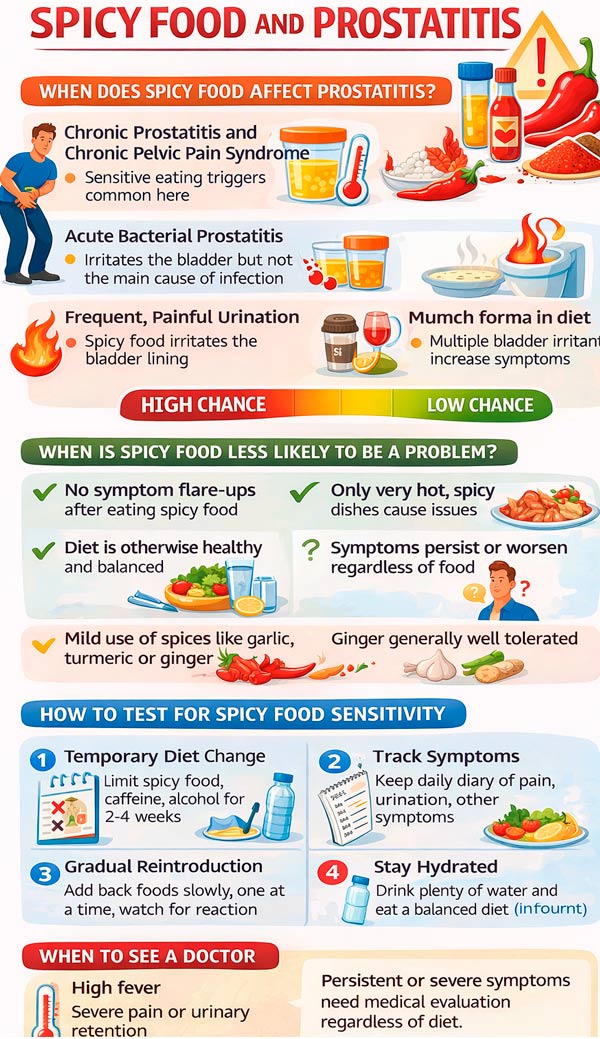
The most sensible practical step is not to immediately identify the "culprit," but to minimize the main bladder irritants for 2-4 weeks. This list most often includes alcohol, caffeine, highly acidic foods, and very spicy foods. This temporary approach is better than endless, chaotic prohibitions, because it allows you to see if your well-being changes at all. [21]
At this stage, a simple diary is helpful. It's enough to record three things daily: the level of pain in the perineum or pelvis, the severity of burning during urination, and the frequency of urination, especially at night. If symptoms noticeably decrease over 2-4 weeks without acute symptoms, there's reason to suspect individual sensitivity. If nothing changes, looking solely at spices as the cause is less logical. This step-by-step approach fits well with the modern concept of personalized patient care. [22]
It's best to reintroduce foods one at a time. Start with a small portion, then observe for 24-72 hours, after which a decision is made whether to keep the food in the diet or remove it again. This method is less stressful and more accurate than abruptly reintroducing several potential triggers at once. It allows you to understand whether your body is reacting specifically to spicy foods, rather than to the combination of spicy foods with alcohol, coffee, or a heavy late dinner. This is a logical consequence of the fact that food sensitivities are individual, and there is no universal diet. [23]
During such trials, it's more important to maintain a healthy diet overall rather than simply going on a dry diet. The Mayo Clinic and the National Institute of Diabetes and Digestive and Kidney Diseases recommend adequate fluid intake for bacterial prostatitis, and a study on food sensitivities in men with chronic prostatitis and chronic pelvic pain syndrome found that water and certain measures that improve bowel regularity were perceived by patients as relieving symptoms. In practice, this means that dehydration and constipation can be just as disruptive as spices. [24]
Particular caution is needed with dietary supplements and "medicinal spices." The Mayo Clinic notes that there is insufficient data on many alternative remedies, and the use of herbal products and supplements is best discussed with a doctor. Therefore, attempts to treat prostatitis with large doses of hot spices, pepper extracts, or harsh "cleansing" mixtures are more likely to create an additional risk of irritation than to provide proven benefit. [25]
| Practical step | Why is it needed? | How much time should be given for evaluation? |
|---|---|---|
| Temporarily remove very sharp | Check if there is a connection with the symptoms | 2-4 weeks |
| Reduce alcohol and caffeine | Reduce overall bladder irritation | In parallel with the first stage |
| Keep a pain and urinary diary | Separate real triggers from coincidences | Daily |
| Return products one by one | Understand the tolerance of a particular product | 24-72 hours per product |
| Monitor your drinking and regular bowel movements | Reduce additional irritants | Constantly |
The chart is based on recommendations from the Mayo Clinic, the National Institute of Diabetes and Digestive and Kidney Diseases, and food sensitivity data in patients with chronic prostatitis and chronic pelvic pain syndrome.[26]
When the problem is no longer in the food, but in the disease itself and its complications
There are situations in which it's too late to discuss pepper and spices. The European Association of Urologists describes acute bacterial prostatitis as a sudden condition characterized by urinary dysfunction, pain, malaise, and fever. In this situation, the primary goal is not a home-based diet, but a rapid assessment of the infection and initiation of treatment. [27]
Warning signs include high fever, chills, a sharp increase in pain, severe difficulty urinating, inability to urinate normally, blood in the urine, or a rapid deterioration in general condition. In such cases, dietary adjustments are not necessary, but rather immediate medical attention or emergency care. Acute bacterial inflammation can be severe and sometimes complicated by an abscess. [28]
The modern diagnostic approach for suspected bacterial prostatitis is well described in the recommendations of the European Association of Urologists. For acute prostatitis, useful tests include a urine dipstick test for nitrites and leukocytes, midstream urine culture, a complete blood count, and, in severe cases, blood culture. These tests are far more important than debates about whether it's safe to eat spicy foods the day before. [29]
There's also an important rule of thumb: in acute bacterial prostatitis, prostate massage should not be performed to "extrude" the secretion. The European Association of Urologists notes that this can cause bacteremia and sepsis, and the Mayo Clinic specifically states that prostate secretion testing after massage is not used in acute bacterial prostatitis precisely because of the risk of spreading infection to the bloodstream. [30]
If symptoms persist for months, but tests show no infection, the situation also won't be resolved by diet alone. In this case, the doctor will consider chronic prostatitis and chronic pelvic pain syndrome, urinary dysfunction, pelvic floor muscle tension, and other causes. Therefore, the lack of effect of abstaining from acute medications doesn't mean "nothing is wrong," but rather that a more precise mechanism for the symptoms needs to be investigated. [31]
| Symptom | How urgent is this? | What to do |
|---|---|---|
| High fever and chills with pain and dysuria | Urgently | Seek emergency medical attention |
| Almost no urine or urination is impossible | Urgently | Urgent urological evaluation is needed. |
| Blood in urine | Urgently or in the near future, depending on the volume and condition | Don't reduce the problem to just nutrition |
| Long-term pelvic pain without fever | Planned, but necessary | Search for chronic prostatitis and chronic pelvic pain syndrome |
| Symptoms do not change despite exclusion of acute | As planned | A full diagnosis is needed, not just a diet. |
The table reflects the clinical recommendations of the European Association of Urology and the Mayo Clinic for the diagnosis and management of prostatitis. [32]
FAQ
Is it generally okay to eat spicy foods if you have prostatitis?
Sometimes it's okay. Current guidelines don't provide a blanket ban for all men with prostatitis. However, if burning, pain, or urinary frequency consistently increases after eating spicy foods, it's worth limiting your consumption of such foods. [33]
Does spicy food cause prostatitis?
There is no convincing evidence that spicy food specifically causes prostatitis. It may be more likely to trigger worsening symptoms in some patients than a proven cause of the disease itself. [34]
Is it absolutely necessary to avoid spicy foods if you have bacterial prostatitis?
During treatment for bacterial prostatitis, doctors often recommend reducing spicy, acidic, caffeinated, and alcoholic foods as they can irritate the bladder. This is a supportive measure to alleviate symptoms, not a replacement for antibiotics and medical supervision. [35]
Why does the burning sensation intensify after an acute attack if the problem is prostate-related?
Because some symptoms are related not only to the prostate gland but also to irritation of the lower urinary tract. Therefore, an acute attack can intensify the subjective burning sensation and increased urinary frequency, even if the inflammation itself is not caused by food. [36]
Should you eliminate all spices at once?
Not necessarily. It's much wiser to temporarily remove the most suspect irritants, then gradually reintroduce foods one at a time and observe the reaction. This approach better aligns with the principle of individual food sensitivity. [37]
If avoiding spicy foods doesn't help, does that mean the problem isn't food?
Often, yes. If symptoms persist, consider a bacterial infection, chronic pelvic pain, urinary dysfunction, or another urological cause, rather than endlessly stricter dieting. [38]
What foods are most often paired with spicy foods as triggers?
Coffee, tea, alcohol, hot peppers, and sometimes acidic foods are most often mentioned. It's important to evaluate not just one food, but the entire range of triggers. [39]
When should you urgently see a doctor instead of experimenting with food?
When there is a fever, chills, severe pain, severe problems with urination, inability to urinate, or blood in the urine. Such symptoms require clinical evaluation, as they may be consistent with an acute bacterial infection or complication. [40]
Key points from experts
H. Henry Lai, MD, chairman and executive director of the Department of Urology at the University of Iowa, is the American Urological Association's director of the Male Chronic Pelvic Pain Guidelines. The modern American approach, associated with his name, is important because it moves away from the simplistic "one diet fits all" model. The main thesis is this: there are no specific universal dietary recommendations, but individual food sensitivities in men with chronic prostatitis and chronic pelvic pain syndrome are common enough to be considered in treatment. [41]
J. Curtis Nickel, MD, Professor Emeritus of Urology at Queen's University, is a researcher in inflammatory and painful diseases of the urinary tract. His long-standing work on prostatitis helps clarify the point: chronic prostatitis is not always an infection, and trying to treat all symptoms with antibiotics or a strict diet alone is usually oversimplifying. For some patients, lifestyle and dietary triggers are important, but they need to be assessed within the broader clinical picture. [42]
Florian Wagenlehner, MD, Director of the Clinic for Urology, Pediatric Urology, and Andrology at the Justus-Liebig University of Giessen, is one of Europe's leading experts on urological infections. His European perspective is particularly valuable in practical terms: if acute bacterial prostatitis is suspected, it is crucial to quickly recognize the infection, obtain the necessary tests, and avoid dangerous prostate massage. Dietary restrictions can reduce bladder irritation, but they should not detract from diagnosis and treatment of the infection itself. [43]
Conclusion
Spicy foods aren't universally prohibited for prostatitis, but they're also not completely indifferent. For some men, especially those with chronic prostatitis and chronic pelvic pain syndrome, spicy foods actually increase pain, burning, and urinary symptoms. For bacterial forms of the disease, temporarily limiting spicy foods, alcohol, and caffeine can improve symptoms, but proper diagnosis and therapy remain the cornerstone of treatment. [44]
The most sensible approach isn't a blind, lifelong ban, but rather testing personal tolerance against a normal, less irritating diet. If there's a connection with food, it quickly becomes apparent. If there's no connection, the cause needs to be investigated further. And if a fever, severe pain, blood in the urine, or urinary retention develop, discussing the menu is out of the question—urgent medical attention is needed. [45]