
Medical expert of the article

New publications
Constipation in cancer: why it occurs, when it is dangerous, and how it is treated
Last updated: 11.04.2026

All iLive content is medically reviewed or fact checked to ensure as much factual accuracy as possible.
We have strict sourcing guidelines and only link to reputable media sites, academic research institutions and, whenever possible, medically peer reviewed studies. Note that the numbers in parentheses ([1], [2], etc.) are clickable links to these studies.
If you feel that any of our content is inaccurate, out-of-date, or otherwise questionable, please select it and press Ctrl + Enter.

Constipation in cancer is more than just infrequent bowel movements and discomfort. For cancer patients, it often becomes part of a more complex clinical picture, as it can be associated with the tumor itself, antitumor treatment, pain management, decreased appetite, dehydration, inactivity, and metabolic disturbances. The US National Cancer Institute clearly states that gastrointestinal complications, including constipation, fecal impaction, and intestinal obstruction, are common in cancer patients and are influenced by both tumor growth and treatment. [1]
Based on current observational data, the prevalence of constipation in patients with cancer varies greatly depending on the stage of the disease, the medications used, and the endpoints. In a national survey of patients in Irish cancer centers, the prevalence of constipation was 67.6%, and a context review for this study reported a range of estimates from approximately 32% to 87%, with the highest values observed in patients receiving opioids and palliative care. [2]
The clinical significance of constipation extends far beyond inconvenience. The US National Cancer Institute emphasizes that long-term constipation can lead to fecal impaction and intestinal obstruction, and fecal impaction in severely ill patients can sometimes become a life-threatening condition. This is especially important for oncology practice, as concomitant weakness, dehydration, analgesic therapy, and neuromuscular impairment increase the risk of severe progression. [3]
There's another important psychological aspect. Constipation in cancer patients is often accompanied by feelings of shame, anxiety, a reluctance to discuss bowel movements with the doctor, and delaying treatment until the situation becomes severe. The National Cancer Institute specifically recommends reporting constipation to the team as early as possible, as early treatment helps prevent fecal impaction and intestinal obstruction. [4]
Therefore, it's more appropriate to consider constipation in cancer as a separate issue in supportive and palliative care. It's not an independent oncological entity, but it's also not a minor complaint. In modern practice, it's considered as seriously as pain, nausea, dehydration, or weight loss, because it directly impacts well-being, nutrition, the ability to accept pain medication, and quality of life. [5]
| Why is the topic important? | What does this mean in practice? |
|---|---|
| Constipation is common in cancer patients. | It needs to be actively identified, not wait for complaints. |
| The reasons are usually multiple. | You can't explain everything by nutrition alone |
| Fecal impaction and intestinal obstruction are possible. | Early treatment and monitoring is required. |
| The symptom affects eating, pain, and daily activities. | This is a full-fledged task of supportive therapy. |
| Patients often report problems late. | The team must ask about the chair itself |
Basis for the table. [6]
Why do people with cancer develop constipation?
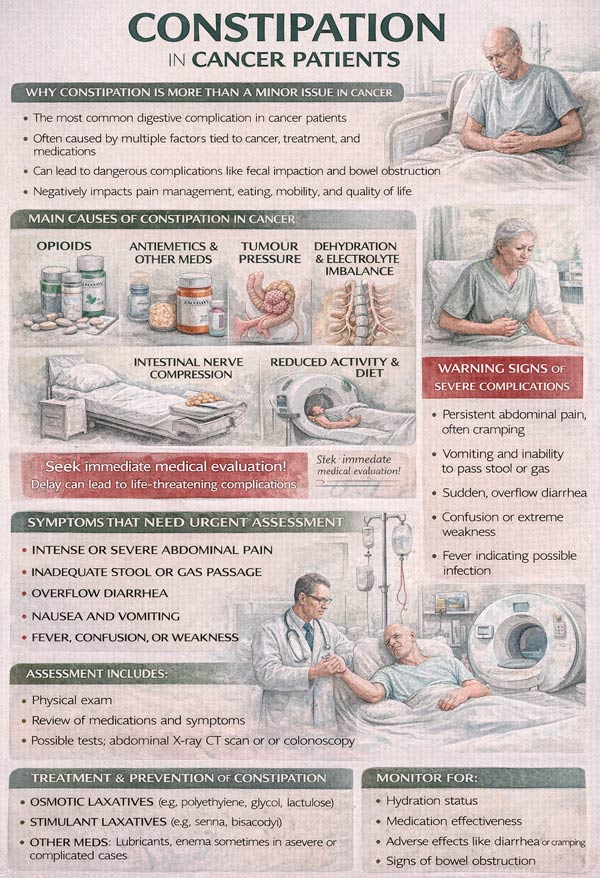
The most obvious mechanism is medication. The US National Cancer Institute notes that in cancer patients, constipation can be caused by opioid painkillers, antiemetics, some chemotherapy drugs, antacids, and diuretics. This is important because, in real-world practice, constipation is rarely associated with just one factor: for example, a patient may be taking an opioid, an antiemetic, and eating less than usual. [7]
The tumor's role is no less important. The US National Cancer Institute states that constipation can be a symptom of tumors that compress abdominal organs, interfere with the movement of stool through the intestines, or affect the nerve structures associated with the intestines. Examples on the patient page include colon cancer, rectal cancer, ovarian cancer, and brain tumors, while a professional review further emphasizes the role of spinal cord compression and intestinal innervation disorders. [8]
Metabolic factors also play a significant role. A professional review by the US National Cancer Institute lists dehydration, hypercalcemia, hypokalemia, and uremia as causes. This is especially relevant for cancer patients, as vomiting, poor fluid intake, loss of appetite, chemotherapy, and tumor progression can quickly shift electrolyte balance and thereby slow intestinal motility. [9]
Another common cause is decreased mobility and general fatigue. The National Cancer Institute lists physical inactivity, prolonged immobilization, and changes in toilet habits as risk factors. In oncology, this is a very common scenario: the patient lies down a lot, eats less often, drinks less, delays the urge to urinate longer, and ultimately experiences hard stools and painful bowel movements, even without a direct mechanical cause. [10]
Finally, constipation may be part of a broader treatment toxicity. A 2023 systematic review of anticancer drugs emphasized that constipation remains an underrecognized adverse event across some drug regimens and is not specific to opioid therapy. Even so, current recommendations remain cautious: first and foremost, it is essential to look for the specific underlying mechanism in a given patient, rather than limiting ourselves to the formula "it's just a side effect of treatment." [11]
| The main reason | How it causes constipation |
|---|---|
| Opioids | Slows down peristalsis and makes stool drier |
| Antiemetics and other medications | They inhibit motility or change the water balance. |
| Tumor compression of the intestine | Mechanically interferes with the passage of stool |
| Compression of nerve structures | Disrupts the regulation of intestinal motility |
| Dehydration and electrolyte shifts | Increases dry stool and intestinal sluggishness |
| Sedentary lifestyle and poor nutrition | Reduces natural stimulation of defecation |
Basis for the table. [12]
How does constipation manifest itself and what signs require urgent assessment?
Constipation in cancer patients doesn't always look the same. The National Cancer Institute lists typical symptoms on its patient page: two or fewer bowel movements per week, dry, hard, or lumpy stools, pain during bowel movements, difficulty passing stool, abdominal cramping, bloating, and nausea. However, the professional version of the review specifically emphasizes that for cancer patients, rigid "norms" for bowel frequency can be inaccurate, so it's more important for a physician to know a specific person's usual rhythm and how it has changed. [13]
That's why one of the best questions in oncology is: what is normal for this patient? Some people had bowel movements every day before their illness, while others only had them every other day. If, during cancer treatment, a person begins straining more intensely, their stools become harder, they experience a feeling of incomplete evacuation, or a noticeable distension in the lower abdomen, this is clinically significant even without extremely infrequent bowel movements. [14]
The situation becomes more dangerous when fecal impaction develops. The US National Cancer Institute describes it as a condition in which hardened fecal matter blocks the rectum or colon and can lead to not only intestinal symptoms but also urinary, cardiovascular, and respiratory symptoms. Symptoms include chronic constipation, a feeling of pressure in the rectum, lower abdominal or lower back pain, urinary difficulties, bloating, sudden "breakthrough" diarrhea, nausea, vomiting, and dehydration. [15]
An even more worrisome scenario is malignant intestinal obstruction. The US National Cancer Institute notes that its possible symptoms include cramping abdominal pain, bloating, nausea, vomiting, failure to pass stool or gas, and sometimes paradoxical diarrhea. Malignant intestinal obstruction is most often associated with tumors of the colon, stomach, and ovaries and is more common in the late stages of the disease. [16]
In practical terms, this means the following. If a patient with cancer experiences constipation accompanied by increasing pain, repeated vomiting, lack of gas, fever, confusion, severe weakness, or sudden diarrhea with prolonged bowel obstruction, it can no longer be considered "regular constipation." An urgent in-person evaluation is necessary, as delay can lead to serious complications. [17]
| Symptom | How to interpret it |
|---|---|
| Hard, rare, painful stools | Typical picture of uncomplicated constipation |
| Bloating and nausea | They may be part of constipation, but require attention to dynamics. |
| Feeling of pressure in the rectum | Suspected fecal impaction |
| Sudden loose diarrhea after prolonged constipation | Fecal impaction with leakage is possible |
| There is no gas, there is vomiting and increasing pain | Suspected intestinal obstruction |
| Fever, confusion, severe weakness | Urgent evaluation of complications is needed. |
Basis for the table. [18]
How a doctor understands the cause of constipation in a cancer patient
Diagnosis begins with a thorough interview, not an automatic prescription for a laxative. The National Cancer Institute recommends asking about a person's usual bowel habits, the time of their last bowel movement, the volume, consistency, and color of the stool, whether there was blood, and whether fever, cramping, pain, bloating, or a feeling of fullness in the rectum have developed. For cancer patients, a list of all medications, including opioids, antiemetics, iron supplements, and diuretics, is also mandatory. [19]
A physical examination is also of great value. On its patient page, the National Cancer Institute emphasizes that the physician examines and palpates the abdomen, looks for areas of tenderness, fullness, and tightness, listens to bowel sounds, and, if necessary, performs a digital rectal examination to detect fecal impaction or other changes. The professional review also includes a separate assessment of gas passage, the presence of bloating, and the condition of the stoma, if present. [20]
Instrumental diagnostics are not necessary for everyone, but rather based on indications. The US National Cancer Institute states that plain abdominal radiography can reveal a tumor or fecal impaction, while the professional version notes that colonoscopy or sigmoidoscopy are used if a tumor within the lumen of the colon is suspected. In the clinical setting of intestinal obstruction, a more accurate method is considered a CT scan of the abdomen and pelvis with contrast. [21]
A key principle of modern cancer care is to recognize situations in which standard advice about water and fiber is not only useless but also harmful. The US National Cancer Institute explicitly states that bulk-forming laxatives, such as psyllium, should be avoided if intestinal obstruction is suspected, and a professional review emphasizes that rectal interventions are contraindicated in some patients with neutropenia, thrombocytopenia, severe mucositis, or immunodeficiency. [22]
Essentially, the doctor decides three questions. First, is it uncomplicated constipation or fecal impaction? Second, is there a mechanical or malignant intestinal obstruction? Third, what is the underlying mechanism in this particular patient—opioids, dehydration, immobility, tumor compression, hypercalcemia, or a combination of causes? Only then is therapy selected. [23]
| Evaluation stage | Why is it needed? |
|---|---|
| Detailed survey about usual stool and medications | Allows you to understand the dynamics and probable cause |
| Abdominal examination and digital rectal examination | They help identify blockages and signs of complications. |
| X-ray of the abdomen | May indicate fecal impaction or tumor cause |
| Computed tomography if obstruction is suspected | Specifies the level and reason for the block |
| Evaluation of contraindications to fiber and rectal procedures | Helps to avoid harm in complicated cases |
Basis for the table. [24]
How to treat uncomplicated constipation in a cancer patient
The modern approach to treatment is stepwise. The US National Cancer Institute emphasizes that prevention, eliminating triggers, and judicious use of laxatives are key, rather than endlessly waiting for natural improvement. For some patients, increasing fluid intake, moderate activity, regular toilet time, drinking a warm drink before an expected bowel movement, and keeping a stool diary can help. [25]
But in oncology, "everyday" correction alone is often insufficient. The Oncology Nurses Society's guidelines recommend using osmotic or stimulant laxatives along with lifestyle education for non-opioid-induced constipation, rather than relying solely on water and exercise. This reflects the reality: a patient with cancer typically has less time and physiological resilience than a generally healthy person with functional constipation. [26]
The National Cancer Institute's patient page lists the main groups of medications: osmotic laxatives, which draw water into the intestinal lumen, such as polyethylene glycol, lactulose, and sorbitol, and stimulant laxatives, such as senna and bisacodyl. A professional review further emphasizes that a comprehensive plan should include addressing reversible causes, not just medication selection. [27]
Diet in oncology requires caution. The US National Cancer Institute explicitly states that high-fiber foods and fiber supplements may worsen symptoms in some patients, so increasing fiber intake should be discussed on an individual basis. This is especially important in cases of severe bloating, poor fluid intake, suspected partial obstruction, and opioid-induced constipation, where bulky fiber is not considered a good choice. [28]
The practical guideline is usually this: the goal of treatment is not a daily formal bowel movement at any cost, but soft, effortless bowel movements at a frequency that is safe for the patient, often once every 1-2 days. This is the goal for opioid-induced constipation described in a professional review by the US National Cancer Institute. If there is no effect, the plan is quickly revised, because delaying treatment in oncology is more dangerous than in the average outpatient. [29]
| Treatment component | Where is his place? |
|---|---|
| Liquid and moderate activity | The basis of therapy, if there are no contraindications |
| Stool diary and toilet routine | Helps to spot deterioration early |
| Osmotic laxatives | Frequent starting drug option |
| Stimulant laxatives | Frequent starter or add-on option |
| Fiber | Only after assessing tolerability and risk of obstruction |
Basis for the table. [30]
Opioid-induced constipation in cancer: a distinct and very common scenario
Opioid-induced constipation holds a special place because opioids remain the mainstay of treatment for moderate to severe pain in many cancer patients. The National Cancer Institute, in a professional review of pain, states that it is the most common adverse effect of opioid therapy and that it occurs in 40%-95% of patients. Unlike nausea and drowsiness, significant tolerance to this effect does not typically develop. [31]
The mechanism is well understood. Opioids reduce peristalsis, decrease secretion, and promote the formation of dry, hard stools. The US National Cancer Institute specifically emphasizes that the condition is aggravated by dehydration, low activity, and associated problems, such as spinal cord compression. Therefore, even "correct" analgesia almost always requires well-thought-out constipation prevention. [32]
Current guidelines from the Oncology Nurses Society explicitly recommend discussing constipation prevention before initiating opioid therapy. For adult patients with opioid-associated cancer, the panel recommends initial treatment with osmotic or stimulant laxatives, along with education on fluid management, movement, and nutrition. A professional review from the National Cancer Institute also states that stimulant laxatives are typically initiated concurrently with opioids. [33]
If a conventional laxative regimen fails, peripherally acting mu-opioid receptor antagonists are the next step. In the Oncology Nurses Society clinical summary, naldemedine, along with the current laxative regimen, has a strong recommendation for opioid-induced constipation in patients with cancer, methylnaltrexone has a conditional recommendation, and naloxegol has a conditional recommendation with very low certainty of evidence. A 2024 systematic review and meta-analysis also concluded that oxycodone with naloxone, naldemedine, and methylnaltrexone are effective in treating such constipation in cancer patients, and naldemedine and magnesium oxide are probably useful for prophylaxis.[34]
It's crucial to remember contraindications. The US National Cancer Institute advises that peripherally acting opioid receptor antagonists should not be used if postoperative intestinal paresis or mechanical intestinal obstruction is suspected. Therefore, before intensifying treatment for opioid-induced constipation, it's important to ensure that the symptom doesn't conceal a more serious underlying cause. [35]
| The situation with opioid therapy | Preferred approach |
|---|---|
| Prescribing an opioid for the first time | Discuss constipation prevention immediately |
| The first signs of constipation | Osmotic or stimulant laxative plus behavioral measures |
| No response to normal mode | Consider drugs that block the intestinal effects of opioids |
| There is a suspicion of obstruction | Do not increase treatment blindly, first exclude complications |
| The goal of therapy | Soft stools without straining, usually every 1-2 days |
Basis for the table. [36]
Prevention, nutrition, and treatment expectations
Preventing constipation in cancer begins not with diet per se, but with risk assessment. If the team knows the patient is starting opioid therapy, is taking medications with a constipating effect, is drinking little, is physically inactive, or has a history of chronic constipation, it's best to act proactively. This preventative approach is reflected in both the National Cancer Institute and the Oncology Nurses Society guidelines. [37]
Fluid and nutrition should be individualized. The National Cancer Institute recommends aiming for approximately 8 cups of fluid per day, unless contraindicated, and discussing fiber with your team, as high-fiber foods are not suitable for everyone. With a good fluid intake and uncomplicated bowel movements, fiber can be helpful, but with severe bloating, suspected obstruction, severe weakness, and poor tolerance to coarse foods, relying solely on fiber can be a mistake. [38]
Physical activity also helps, even if it's minimal. The National Cancer Institute recommends not only walking but also light exercise in bed or a chair if a person is unable to move actively. For cancer patients, the principle of regular movement itself is more important than achieving a physical fitness level. Any safe activity helps maintain intestinal motility better than complete rest. [39]
At the same time, treatment expectations should be realistic. Constipation in cancer is often associated with multiple causes, so it is rarely resolved with a single product or medication. Sometimes, a review of pain management, correction of dehydration, treatment of hypercalcemia, exclusion of obstruction, a regular laxative regimen, and the support of a palliative care team are necessary. A 2022 Irish study found that patients receiving specialized palliative care had less severe constipation symptoms, despite a high rate of opioid use. [40]
The prognosis depends not only on the constipation itself but also on the overall oncological context. In uncomplicated drug-induced constipation, the symptom can often be controlled. In cases of fecal impaction and especially malignant intestinal obstruction, the situation is more complex and requires a different approach. Therefore, the key principle here is simple: the sooner constipation is noticed and discussed, the higher the chance of preventing it from developing into dangerous complications. [41]
| Preventive measure | When it's especially important |
|---|---|
| Preventative talk before starting opioids | Before the first dose of pain medication |
| Drinking enough fluids | For poor appetite, vomiting, fever and weakness |
| Individual fiber assessment | For bloating, loss of appetite and risk of obstruction |
| Moderate daily activity | Even for a patient with limited mobility |
| Early contact with the palliative care team | With multiple risk factors and difficult to control constipation |
Basis for the table. [42]
Frequently Asked Questions
Can constipation be the first sign of cancer?
Yes, sometimes it can. The National Cancer Institute notes that constipation can be a symptom of tumors that compress abdominal organs, interfere with the movement of stool through the intestines, or affect the nerve structures connected to the intestines. But much more often, in already diagnosed cancers, constipation is associated with treatment, dehydration, opioids, or decreased activity. [43]
Should all cancer patients start taking laxatives right away?
No, not everyone automatically. But if opioid therapy is being started or there is already a high risk of constipation, current guidelines recommend discussing prevention early and often initiating a bowel movement early rather than waiting for complications. [44]
Can I just increase my fiber and water intake?
Sometimes this is sufficient, but not always. The US National Cancer Institute emphasizes that fiber and its supplements can actually worsen the condition in some patients, especially if there is significant bloating or risk of intestinal obstruction. Therefore, nutrition for cancer patients should not be a one-size-fits-all approach, but rather individualized. [45]
Why is fecal impaction dangerous?
It's a condition in which hardened stool blocks the rectum or colon. The National Cancer Institute describes it as a potentially life-threatening complication that can cause pain, nausea, vomiting, difficulty urinating, confusion, and even paradoxical loose diarrhea. [46]
How do you know if it's not just regular constipation, but intestinal obstruction?
Warning signs include increasing abdominal pain, severe bloating, vomiting, lack of gas and stool, and sometimes loose stool that breaks through the blockage. This requires urgent evaluation rather than self-administering laxatives. [47]
What drugs are currently considered the most promising for opioid-induced constipation in cancer patients?
If a standard laxative regimen fails, naldemedine has the strongest recommendation, with methylnaltrexone and naloxegol also being considered. A 2024 systematic review confirmed the efficacy of naldemedine and methylnaltrexone in cancer patients with acceptable safety. [48]
Key points from experts
Philip Larkin is a professor of palliative care and palliative nursing at the University of Lausanne and one of the authors of the European Society for Medical Oncology clinical guidelines on constipation in advanced cancer. His work is important because it cemented the modern view of constipation as a multifactorial problem, where symptoms, medications, metabolic causes, and the risk of bowel obstruction must be assessed simultaneously, rather than treating everyone the same. [49]
Nathan Cherny is the director of the Oncology Pain and Palliative Care Service at Shaare Zedek Medical Center, a professor, and one of the key authors of the European Society for Medical Oncology guidelines on constipation in advanced cancer. His expert position is particularly important for practice because it links constipation treatment with pain relief: good pain control should not be achieved at the cost of ignoring opioid-induced constipation and its complications. [50]
Christine LeFevre, DNP, an oncology clinical specialist with the Oncology Nurses Society, co-authored a clinical summary and guideline on opioid-induced and non-opioid-induced constipation in adult patients with cancer. Her contribution is important because it translates recommendations into everyday practice: prophylaxis before initiating opioids, early initiation of osmotic or stimulant laxatives, and rapid transition to the next step of treatment if there is no response. [51]