
Medical expert of the article

New publications
Vegetables for constipation: which ones help, how to introduce them, and when they don't solve the problem
Last updated: 04.04.2026

All iLive content is medically reviewed or fact checked to ensure as much factual accuracy as possible.
We have strict sourcing guidelines and only link to reputable media sites, academic research institutions and, whenever possible, medically peer reviewed studies. Note that the numbers in parentheses ([1], [2], etc.) are clickable links to these studies.
If you feel that any of our content is inaccurate, out-of-date, or otherwise questionable, please select it and press Ctrl + Enter.
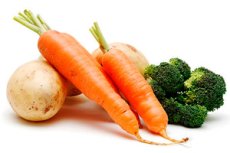
Vegetables have long been considered one of the most logical foods for constipation, and there is a real medical basis for this. International guidelines for chronic constipation list vegetables as important sources of dietary fiber, and the US National Institute of Diabetes and Digestive and Kidney Diseases specifically states that adults typically need 22-34 grams of fiber per day, and lists vegetables, including carrots, broccoli, green peas, and leafy greens, as good sources. [1]
But the modern view is much more nuanced than the old advice to "eat more vegetables." The World Gastroenterology Organization, in its 2025 guidelines, emphasizes that fiber is indeed considered a first-line treatment for chronic constipation, but its effectiveness is not equal for all subtypes of constipation. Furthermore, in some conditions, including obstructive bowel diseases and bowel dysfunction, too much fiber may be undesirable. [2]
This is especially important because the word "constipation" encompasses a variety of mechanisms. For some people, the problem is primarily related to low plant food and fluid intake. For others, the main contributor is slow colon transit. For others, difficulty arises during the evacuation of stool from the rectum. This is why vegetables may help one person and provide little benefit to another, even though their complaints are similar. [3]
Another important issue concerns the level of evidence. In 2025, the British Dietetic Association released the first comprehensive evidence-based dietary guidelines for adults with chronic constipation. These guidelines supported some specific foods, such as kiwi, prunes, and rye bread, but for a high-fiber diet of an unspecified range of foods and drinks, there was insufficient high-quality randomized evidence. This doesn't mean vegetables are useless. It does mean that there are fewer direct trials of "more vegetables for constipation" than would be desirable. [4]
Therefore, the most honest conclusion at the beginning of the article is this: vegetables are important for constipation, but not as a magic cure. They should be considered as part of a strategy that includes water, a gradual increase in fiber, physical activity, and, if necessary, medications with proven effectiveness. This approach is consistent with both current guidelines and real-world clinical data. [5]
| The main question | What does current data show? |
|---|---|
| Vegetables are good for constipation | Yes, as an important source of dietary fiber |
| Vegetables cure any constipation | No, the effect depends on the mechanism of constipation |
| Is there strong randomized data specifically on vegetables as a group? | There are not enough of them yet. |
| Do I need to increase my vegetables drastically? | No, only gradually |
| Can vegetables make you feel worse? | Yes, for bloating, evacuation problems and some intestinal diseases |
Data for the table: [6]
What research shows specifically about vegetables
Looking at the most recent data, vegetables appear beneficial primarily in large observational studies. In an analysis of data from the US National Nutrition and Health Survey, which included 13,832 adults, higher vegetable consumption was associated with a lower likelihood of constipation. After adjusting for multiple factors, people in the top quartile of vegetable consumption were less likely to have constipation than those in the bottom quartile, with an odds ratio of 0.60. [7]
In another 2024 study, also using American population data, the authors showed that the association was particularly strong for non-starchy vegetables. The strongest association with a reduced risk of constipation was observed for tomatoes, while the consumption of potatoes and other starchy vegetables showed no such association. This is an important observation because it suggests that it may not just be the quantity of vegetables consumed, but their type, that is crucial. However, the study remains observational, and therefore does not prove a cause-and-effect relationship. [8]
There's another interesting finding. A study published in 2024 in the Proceedings of the Nutrition Society found that people with constipation who ate vegetables at least once a day had a higher average stool weight than those who ate vegetables less frequently. This doesn't necessarily mean an immediate resolution of symptoms, but it's a physiologically important sign: higher stool weight typically means more stool volume in the intestinal lumen and better potential for movement. [9]
However, the same authors also made a very important caveat: even with higher stool weights, more frequent fruit and vegetable consumption alone was not necessarily sufficient to completely overcome constipation symptoms. This result greatly dampens excessive expectations. Vegetables improve the background, but they are not required to replace comprehensive therapy in people with chronic, long-term, and severe constipation. [10]
Finally, it's important to remember the limitations of this entire database. Both the study on vegetable quantity and the study on vegetable subtypes were cross-sectional analyses, not interventions. The British Dietetic Association specifically emphasizes that there is insufficient randomized evidence for a high-fiber, unspecified diet. Therefore, it's scientifically accurate to say that vegetables are associated with a lower likelihood of constipation and higher stool weights, but direct evidence that a specific "vegetable diet" treats chronic constipation in all adults is still lacking. [11]
| Data type | What is shown | Limitation |
|---|---|---|
| The NHANES large study on vegetable intake | More vegetables linked to lower risk of constipation | Observational design |
| Research on vegetable subtypes | Non-starchy vegetables, especially tomatoes, are associated with a lower risk of constipation. | Does not prove causality |
| Stool mass testing in people with constipation | More frequent vegetable consumption is associated with larger stool weights. | The symptoms did not go away automatically. |
| Evidence-based guidelines from the British Dietetic Association | There is insufficient randomized evidence for a "high-fiber diet in general" | Better quality interventions are needed |
| International guidelines | Fiber and vegetables are important, but not equally important for all subtypes of constipation. | An individual approach is required |
Data for the table: [12]
Which vegetables seem like the most sensible choice for constipation?
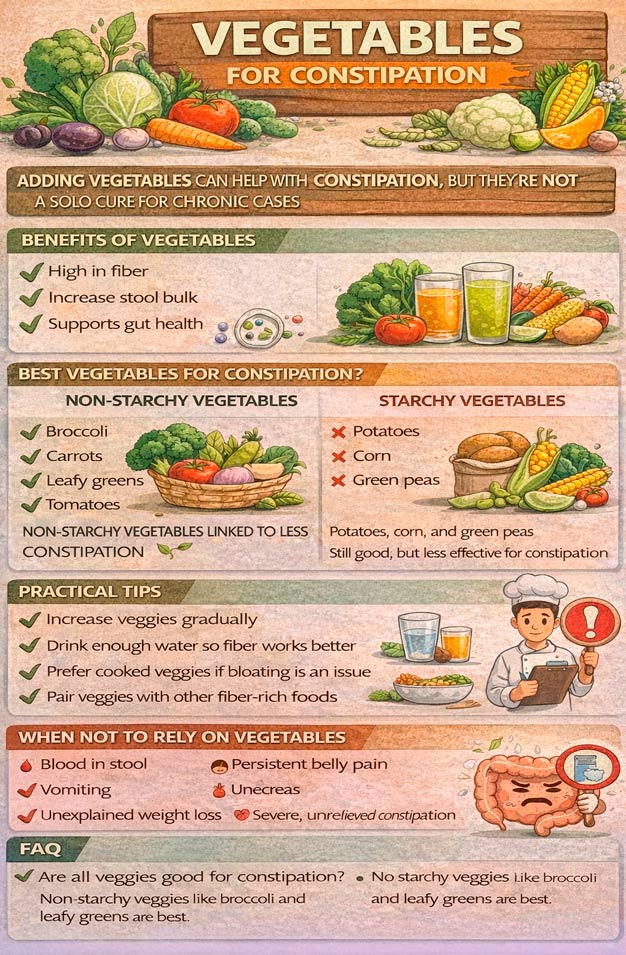
From a practical standpoint, it's most logical to categorize vegetables not as "healthy" or "bad," but rather as those that are more or less beneficial for the gut in a given situation. The official publication of the National Institute of Diabetes and Digestive and Kidney Diseases (NIDK) lists carrots, broccoli, green peas, and leafy greens as good sources of fiber. This isn't a ranking of the best vegetables, but rather a guideline that vegetables with real fiber and water content deserve priority. [13]
Based on current observational data, non-starchy vegetables appear to be the most promising group. A 2024 study found a link between this group and a lower incidence of constipation, compared to potatoes and other starchy vegetables. This doesn't mean potatoes are harmful. It does mean that when developing a diet for constipation, it's better to focus on a more varied selection of non-starchy vegetables rather than on them. [14]
In clinical dietetics, it's reasonable to distinguish three particularly useful subgroups. The first is leafy and soft vegetables, such as leafy greens, zucchini, and soft-cooked vegetable mixes. The second is vegetables with a good balance of soluble and insoluble fiber, such as carrots and broccoli. The third is vegetables that are easy to incorporate into prepared dishes, such as tomatoes, vegetable soups, and stews. This classification is based partly on official examples of good fiber sources and partly on practical tolerability, meaning it combines data with clinical logic. [15]
Potatoes are a separate issue. Johns Hopkins Medicine notes that potatoes contain soluble fiber inside and insoluble fiber in the skin, so in some ways they may help prevent constipation. However, when looking at more recent population data by vegetable subtype, potatoes and starchy vegetables specifically did not demonstrate the same association with a reduced risk of constipation as non-starchy vegetables. This is a good example of how a vegetable can be perfectly acceptable, but not the most important. [16]
Another mistake that's crucial to avoid is that not all vegetables are equally well-tolerated. Cruciferous vegetables, legumes, and some other carbohydrate-rich foods can increase gas production. The Cleveland Clinic explicitly states that many high-fiber carbohydrate foods, including vegetables, can cause gas and bloating. This isn't a reason to completely avoid fiber, but it is a reason to choose the amount and form more carefully. [17]
| Vegetable group | Why are they useful for constipation? | What to look out for |
|---|---|---|
| Non-starchy vegetables | In population data, associated with a lower likelihood of constipation | They don't give a quick effect on their own. |
| Carrots, broccoli, leafy greens | Officially named as good sources of fiber | Increase gradually |
| Tomatoes | In the 2024 study, had the most significant association with a reduced risk of constipation | This is observational data. |
| Potatoes with skins | Provides both soluble and insoluble fiber | Does not belong to the most promising group according to population data |
| Cruciferous vegetables | They are good for fiber, but in some people they increase gas formation. | Tolerability and preparation method are important |
Data for the table: [18]
How to introduce vegetables for constipation so that they help rather than hinder
The most important rule is to increase vegetable intake gradually. The World Gastroenterology Organization recommends reaching the target intake of 20-30 grams of total fiber per day over a period of weeks, not just a few days. The organization specifically warns that increasing fiber too quickly can lead to gas, bloating, and abdominal cramps. This is what often leads people to mistakenly conclude that vegetables are "not good for them." [19]
The second rule is to keep vegetables and water in the diet. The National Institute of Diabetes and Digestive and Kidney Diseases (NIDDK) emphasizes that water and other fluids help fiber work better and make stool softer and easier to pass. Sharply increasing your vegetable intake but drinking very little water can have the opposite effect: a feeling of heaviness, bloating, and hard stools. [20]
The third rule concerns the method of preparation. Official Johns Hopkins Medicine materials note that cooked vegetables are a source of soluble fiber, and in practice, cooked versions are often better tolerated than large portions of raw fiber. This doesn't mean raw vegetables are bad. It does mean that if you're prone to bloating and discomfort, it's wiser to start with soups, stews, and soft side dishes, and then carefully increase the proportion of raw foods. [21]
The fourth rule is to look at the entire diet, not just the salad. If your diet is low in whole grains, nuts, legumes, fruits, and water, adding a cucumber or a few lettuce leaves alone won't solve the problem. International guidelines for constipation consider vegetables as part of an overall diet, not as an isolated home remedy. [22]
The fifth rule is not to confuse the lack of an immediate effect with futility. In a 2024 study measuring stool mass, more frequent vegetable consumption increased stool mass, but this alone was not sufficient to completely control symptoms. In practice, this suggests that the vegetable strategy works more as a background improvement than as a one-day "quick-start" for bowel movements. [23]
| Practical principle | What to do |
|---|---|
| Introduce fiber gradually | Increase your vegetable intake over weeks, not days. |
| Always add liquid | Drink enough water to make the fiber work. |
| Choose a form based on portability | When bloating, start with cooked vegetables. |
| Work with the whole diet | Don't expect one vegetable to solve the problem |
| Evaluate the effect over time | Count softer, more regular stools as success, not instant results. |
Data for the table: [24]
When vegetables can make you feel worse and when you need to see a doctor
While vegetables are generally beneficial, there are situations where they can exacerbate complaints. The Cleveland Clinic notes that many carbohydrate- and fiber-rich foods, including vegetables, can cause gas. A person with a sensitive gut may notice that trying to "eat more vegetables" increases bloating, bloating, and pain. This doesn't always mean vegetables are harmful. More often, it means the rate of increase or the form of the food was chosen too aggressively. [25]
The combination of constipation with bloating and pain requires special caution in people with irritable bowel syndrome. Monash University emphasizes that foods high in fermentable carbohydrates can worsen symptoms, including gas and pain, and that a diet restricting such carbohydrates should be implemented under the supervision of a specialist and is not intended for uncontrolled long-term use. This is important because, with this type of symptom, the same vegetable may be well-tolerated in small portions but poorly tolerated in large ones. [26]
Furthermore, the World Gastroenterology Organization explicitly states that a high-fiber diet should be avoided in cases of obstructive bowel disease, and fiber and fiber supplements are also not always appropriate for bowel disorders. This is a key clinical nuance: not every constipation can be treated by increasing vegetable intake. Sometimes the problem lies in motility, the pelvic floor, or a structural cause, and then attempting to further increase fiber may only increase discomfort. [27]
Finally, vegetables shouldn't delay seeking medical attention for worrisome symptoms. The National Institute of Diabetes and Digestive and Kidney Diseases advises seeking medical attention if constipation doesn't improve with self-care or if it's accompanied by rectal bleeding, blood in the stool, persistent abdominal pain, or other signs of a medical problem. [28]
The most practical conclusion of this section is this: vegetables should be selected based on tolerance and the clinical situation. They work well as part of a sensible diet for common functional constipation. However, if they significantly worsen your condition, if there is persistent bloating and pain, or if there are warning signs, it's more important not to insist on vegetables, but to address the underlying cause of the constipation. [29]
| Situation | What to do |
|---|---|
| Gas and bloating appeared after a sharp increase in vegetables | Slow down, reduce portions, switch to prepared forms |
| I have irritable bowel syndrome and bloating. | Choose vegetables carefully, preferably with the advice of a nutritionist. |
| Suspected evacuation obstruction or obstruction | Don't increase fiber at random |
| Constipation does not go away with self-help | See a doctor |
| There is blood in the stool, constant pain, and other alarming symptoms | Do not experiment at home, get examined |
Data for the table: [30]
Conclusion
Vegetables are indeed important for constipation, but not because they are a special "healing food." Their value lies in their ability to increase overall fiber intake, water intake, and bowel volume. The most compelling evidence suggests that higher vegetable intake, especially non-starchy vegetables, is associated with a lower risk of constipation and greater stool bulk. [31]
However, there is no strong contemporary evidence that any single vegetable diet is equally effective in treating chronic constipation in adults. Vegetables should be considered as part of a comprehensive strategy along with water, a gradual increase in fiber, physical activity, and, if necessary, medication according to international guidelines. [32]
The most sensible approach is to focus on a variety of non-starchy vegetables, gradually increasing their intake, assessing tolerance, especially if you're experiencing bloating, and not expecting a single bowl of salad to have a strong laxative effect. This approach is both physiological and closest to what current data actually confirms. [33]
FAQ
Which vegetables are best for constipation?
A variety of non-starchy vegetables is the smartest choice. A 2024 observational study found that this group was associated with a lower risk of constipation, and the National Institute of Diabetes and Digestive and Kidney Diseases specifically lists carrots, broccoli, green peas, and leafy greens as good sources of fiber. [34]
Is it true that raw vegetables are always better than cooked ones?
No. In real-life situations, cooked vegetables are often better tolerated, especially if you have bloating or sensitive intestines. Johns Hopkins Medicine notes that cooked vegetables contain soluble fiber, while the World Gastroenterology Organization warns that increasing crude fiber too quickly can increase gas and cramping. [35]
Can constipation be treated with vegetables alone?
No. Even a 2024 study measuring stool weight found that more frequent vegetable consumption was associated with greater stool weight, but this was not sufficient to completely control symptoms. For chronic idiopathic constipation, international guidelines recommend a broader, stepwise approach, including medications with proven efficacy. [36]
Why does eating vegetables sometimes make your stomach worse?
Most often, it's due to too much fiber or poor tolerance to certain vegetables. The Cleveland Clinic notes that carbohydrate- and fiber-rich foods, including vegetables, can cause gas, while the World Gastroenterology Organization recommends increasing fiber gradually. [37]
Are potatoes considered a beneficial vegetable for constipation?
Potatoes with the skin can provide both soluble and insoluble fiber, but population data show they haven't shown the same association with a reduced risk of constipation as non-starchy vegetables. Therefore, potatoes are acceptable, but they shouldn't be relied upon as a primary dietary source. [38]
Is a special diet restricting fermentable carbohydrates necessary?
Only if there are appropriate symptoms and a diagnosis, usually irritable bowel syndrome with severe bloating and pain. Monash University emphasizes that such a strategy should be implemented under the guidance of a specialist and is not simply a "fad diet for everyone." [39]
When should you see a doctor instead of just changing your vegetables?
When constipation doesn't resolve with self-care, when there's blood in the stool, persistent abdominal pain, or other alarming signs. In such cases, the National Institute of Diabetes and Digestive and Kidney Diseases recommends a medical evaluation rather than continuing home experiments. [40]
Key points from experts
Eirini Dimidi, PhD, RD, Reader in Nutritional Sciences, King's College London.
Her work is particularly important for this topic because she led the development of the first evidence-based dietary guidelines for chronic constipation in adults. The key practical message from this work is that nutrition for constipation should be judged not by the popularity of advice, but by the quality of randomized trials. For vegetables, this means they are important as part of a healthy diet, but the evidence base for a "high-fiber diet in general" is not yet as strong as is commonly believed. [41]
Kevin Whelan, Professor of Dietetics, Department of Nutritional Sciences, King's College London.
His research focuses on gastrointestinal diseases and nutrition. Particularly relevant to the topic of vegetables is the finding that not only grams of fiber are important, but also tolerance, dietary structure, and the patient's clinical phenotype. This explains why vegetables can improve stool bulk but not alleviate symptoms in all people with chronic constipation. [42]
William D. Chey, MD, professor of gastroenterology and nutrition, Chief, Division of Gastroenterology and Hepatology, University of Michigan.
His work on the American Gastroenterological Association and American College of Gastroenterology guidelines reminds us that a stepwise strategy is important for chronic idiopathic constipation. This leads to a simple clinical conclusion: vegetables and fiber are important, especially when initial intake is low, but diet alone is not sufficient for severe and persistent constipation. [43]
Lin Chang, MD, professor of medicine at UCLA, is an expert in chronic constipation and disorders of the gut-brain interface.
Her clinical expertise is particularly useful for practice because it helps us view constipation not as a single symptom, but as a group of conditions. From this perspective, vegetables are a good tool, but not a universal one. While they may be helpful for a patient with simple functional constipation, they will only increase discomfort in a patient with bloating, pain, or impaired evacuation without individualized adjustments. [44]