
Medical expert of the article

New publications
Tests for constipation: which tests are really necessary and when
Last updated: 06.04.2026

All iLive content is medically reviewed or fact checked to ensure as much factual accuracy as possible.
We have strict sourcing guidelines and only link to reputable media sites, academic research institutions and, whenever possible, medically peer reviewed studies. Note that the numbers in parentheses ([1], [2], etc.) are clickable links to these studies.
If you feel that any of our content is inaccurate, out-of-date, or otherwise questionable, please select it and press Ctrl + Enter.

Constipation is not a separate disease, but a symptom that can be caused by a variety of mechanisms: from a low-fiber diet and inactivity to pelvic floor muscle coordination disorders, endocrine disorders, and colon tumors. This is why modern diagnostics begin not with a long list of tests, but with understanding the specific type of constipation being diagnosed: episodic, chronic, difficult to pass, infrequent stools, a feeling of blockage, or a combination of several. The World Gastroenterology Organization emphasizes that chronic constipation is a multifactorial condition, and the diagnostic approach should be stepwise and clinically meaningful. [1]
Current guidelines agree on one key point: for most patients, the first step should be a focused history and physical examination, rather than an automatic referral to "get it all." The American Society of Colon and Rectal Surgeons, in its 2024 guidelines, specifically recommends a focused history and physical examination for all patients with constipation, as these help distinguish a functional problem from conditions that require urgent exclusion of serious pathology. [2]
A constipation medical history is not just a formality. It helps to understand how long the symptoms have been present, what specifically bothers you, the stool type, whether there is straining, a feeling of incomplete evacuation, the need for digital assistance, bloating, pain, and what medications the person is taking. The American Society of Colon and Rectal Surgeons guidelines specifically list medications commonly associated with constipation: opioids, antidepressants, anticholinergics, calcium channel blockers, and calcium supplements. [3]
Tests and imaging studies are especially important if so-called warning signs are present. These include blood in the stool or rectal bleeding, weight loss, anemia, noticeable changes in bowel habits, a family history of colorectal cancer, and situations where symptoms do not fit with typical functional constipation. It is in these circumstances that the American Society of Colon and Rectal Surgeons recommends endoscopic examination rather than symptomatic treatment alone. [4]
Finally, it's important to remember that even with chronic constipation, not all tests are needed immediately. The World Gastroenterology Organization states that constipation is generally a symptom-based disorder, for which a limited number of tests are usually sufficient to rule out other diagnoses. Advanced colon, rectal, and anal function tests are recommended only after organic causes have been ruled out and first-line treatment has failed. [5]
| What is assessed at the beginning? | Why is this necessary? | When it's especially important |
|---|---|---|
| The nature of complaints and duration of symptoms | Allows you to understand whether it is functional constipation, a bowel movement disorder or a secondary cause | In all patients with constipation [6] |
| Medicines and concomitant diseases | Constipation is often drug-induced or secondary. | When taking opioids, antidepressants, calcium channel blockers, calcium preparations [7] |
| Warning signs | Helps detect cancer, anemia, bleeding and other serious causes | In case of blood in the stool, weight loss, anemia, change in bowel habits [8] |
| Do you need a large set of tests at once? | Usually not unless there are clinical clues. | In uncomplicated onset, examination and selective tests are often sufficient [9] |
The Basics: Which Blood, Stool, and Urine Tests Are Actually Useful?
A physical examination for constipation is not a secondary component but a genuine diagnostic tool. The National Institute of Diabetes and Digestive and Kidney Diseases recommends that the physician assess for signs of dehydration, the abdomen for distension, tenderness, and masses, and perform a rectal examination. The American Society of Colon and Rectal Surgeons adds that a digital rectal examination may reveal anal hypertonicity, paradoxical contractions of the pelvic floor muscles, a rectocele, a stricture, a tumor, or fecal impaction. [10]
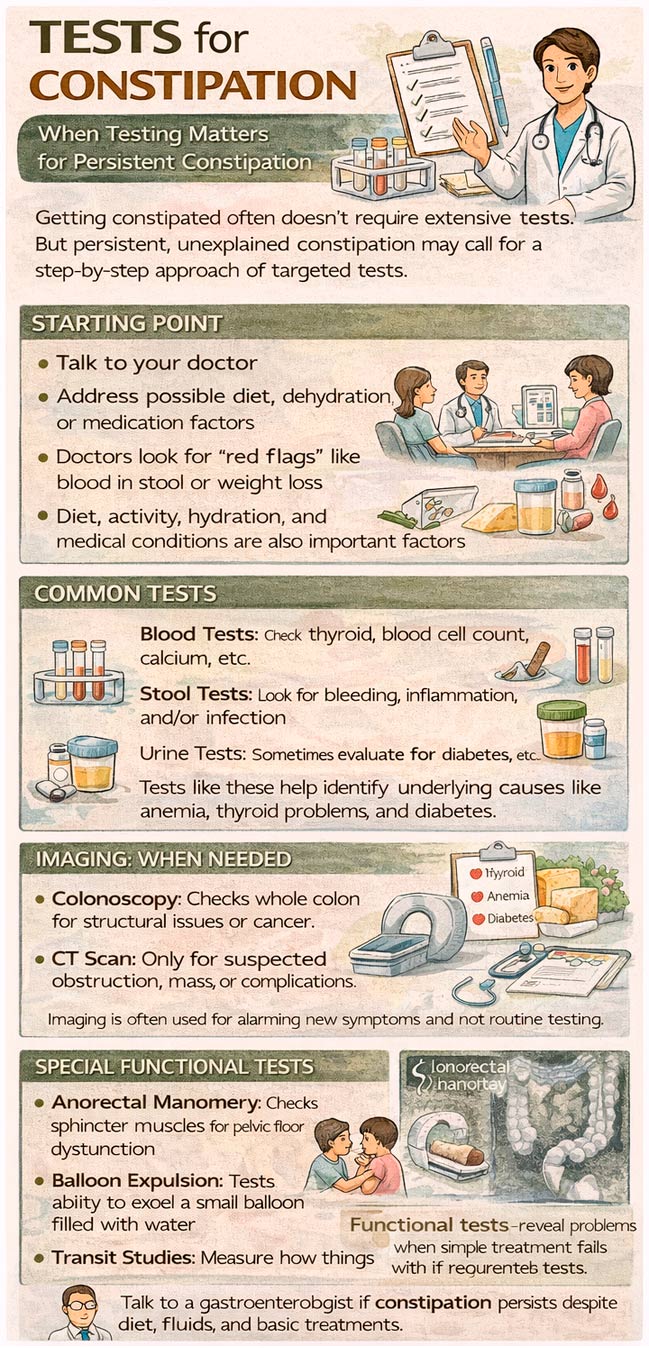
When a secondary cause is suspected after examination, the doctor orders selective laboratory tests. The World Gastroenterology Organization lists blood tests used as indicated: complete blood count, biochemical profile, calcium and glucose levels, and thyroid function tests. The American Society of Colon and Rectal Surgeons confirms that laboratory tests can help detect hypothyroidism, hyperparathyroidism, and diabetes mellitus, although they are not specific for constipation. [11]
The National Institute of Diabetes and Digestive and Kidney Diseases makes the list even more practical for patients. According to them, blood tests can reveal signs of anemia, hypothyroidism, and celiac disease; stool tests can help detect blood, inflammation, and infection; and urine tests can provide clues to conditions like diabetes. This means that laboratory tests for constipation are focused not on the symptom itself, but on the possible underlying disease. [12]
In practice, this is how it works: if a person's constipation is accompanied by fatigue, pallor, weight loss, iron deficiency, dry skin, cold intolerance, thirst, polydipsia, or a family history of autoimmune diseases, the range of tests will be broader. However, if the doctor presents with typical functional constipation without alarming signs and without clinical hints of an endocrine or inflammatory cause, the laboratory program usually remains limited. This selective approach is in line with both the World Gastroenterology Organization and the National Institute of Diabetes and Digestive and Kidney Diseases. [13]
It's also crucial to understand the limitations of the laboratory phase. Neither a complete blood count, nor calcium, nor glucose, nor a thyroid profile reveal the exact cause of poor bowel movement: whether it's due to slow transit, a pelvic floor disorder, or a combination of the two. These tests are needed to identify reversible causes and associated conditions. If the problem lies in impaired evacuation, functional tests, rather than "more blood tests," will be required. [14]
| Analysis | What can it show? | When it is especially useful |
|---|---|---|
| Complete blood count | Anemia, indirect signs of chronic blood loss or inflammation | In case of weakness, weight loss, suspicion of blood in the stool [15] |
| Biochemical profile | Metabolic disorders, indirect signs of secondary causes | For chronic or unexplained constipation [16] |
| Blood calcium | May indicate hyperparathyroidism or another metabolic disorder | For persistent constipation without an obvious dietary cause [17] |
| Blood glucose and sometimes urine | A hint of diabetes as a secondary cause | For thirst, frequent urination, polydipsia, neuropathy [18] |
| Thyroid function tests | Allows one to suspect hypothyroidism | For drowsiness, chills, dry skin, weight gain [19] |
| Celiac disease tests | Needed if there is a suspicion of an autoimmune intestinal background | When combined with anemia and other systemic symptoms [20] |
| Stool examination | Looks for blood, inflammation, infection | If a secondary intestinal cause or blood loss is suspected [21] |
Endoscopy and Imaging: Who Really Needs a Colonoscopy and Who Doesn't
One of the most common questions about constipation is whether a colonoscopy is necessary immediately. The current answer is: not for everyone. Guidelines from the American Society of Colon and Rectal Surgeons indicate that constipation as a sole complaint was not associated with an increased risk of colorectal cancer in a meta-analysis of observational studies. This means that isolated chronic constipation without warning signs does not automatically necessitate a colonoscopy. [22]
But there are important exceptions to this rule. The same guidelines emphasize that colonoscopy should be recommended if the patient already meets standard screening criteria for age and risk, or if there are warning signs: blood in the stool, rectal bleeding, weight loss, changes in stool size or habits, a strong family history of colorectal cancer, or anemia. In such a situation, constipation is no longer considered a harmless functional complaint, but rather a reason to rule out organic pathology. [23]
The National Institute of Diabetes and Digestive and Kidney Diseases advises that for constipation, endoscopic evaluations may include colonoscopy or flexible sigmoidoscopy, with a biopsy performed during the procedure if necessary. This is especially important when the physician needs to rule out a tumor, inflammatory disease, structural stenosis, or other lower intestinal pathology. [24]
Computed tomography (CT) and other imaging techniques are also not routine tests for typical chronic constipation. The American Society of Colon and Rectal Surgeons (ASCR) writes that CT may show colonic dilation or significant fecal impaction, but without symptoms suggestive of an anatomical problem or obstruction, it rarely provides definitive answers. In other words, imaging is useful when clinical evidence suggests the problem may be organic rather than simply functional. [25]
Therefore, endoscopy and imaging for constipation are needed not just for show, but for a specific purpose. If the doctor suspects a tumor, stricture, massive fecal overflow, external compression, inflammation, or other serious pathology, these tests are warranted. However, if a person has long-term functional constipation without alarming symptoms, these methods are usually inferior in priority to a thorough examination, selective tests, and motility assessment. [26]
| Study | When is it usually necessary? | When it is usually not necessary as a first step |
|---|---|---|
| Colonoscopy | For blood in stool, anemia, weight loss, changes in bowel habits, family risk of colorectal cancer, indications for age-related screening | In isolated chronic constipation without alarming signs [27] |
| Flexible sigmoidoscopy | When to evaluate the distal bowel | Does not replace a full analysis of the causes of functional constipation [28] |
| Computed tomography | If dilation, obstruction, mass, external compression, complication is suspected | In uncomplicated typical constipation, as a routine test it is usually of little information [29] |
| Biopsy during endoscopy | If cancer or other tissue pathology is suspected | Not needed without endoscopic grounds [30] |
Functional tests: when routine tests no longer answer the main question
If the medical history, physical examination, and basic tests fail to explain the problem, and constipation persists despite dietary modifications, fiber, and laxatives, then functional testing becomes paramount. The World Gastroenterology Organization explicitly states that advanced colon, rectal, and anal function testing is recommended after organic causes have been ruled out and first-line treatments have failed. This is important: such tests do not look for "blood inflammation," but rather for the mechanism of constipation itself. [31]
One of the main tests in this group is anorectal manometry. The American Society of Colon and Rectal Surgeons' guidelines explain that it records pressure in the rectum and anal canal at rest, during contractions, and during straining. Together with a sensitivity test, it helps determine whether there is a loss of coordination, tone, or sensation. Essentially, this test shows whether the pelvic floor and anal canal muscles are able to relax when a person attempts to defecate. [32]
The balloon expulsion test is also very useful. The manual states that this is a simple, direct evacuation test: the patient must expel a balloon filled with 50 milliliters of water. A delay or failure of expulsion indicates an evacuation disorder. While the test has high specificity and good reproducibility, its sensitivity is low, around 50%, meaning a normal result does not always completely rule out the problem. [33]
To determine how slowly contents move through the colon, a colonic transit test is used. The American Society of Colon and Rectal Surgeons notes that the most common option is a test with radiocontrast markers because it is readily available, inexpensive, and simple. Scintigraphy and a wireless capsule for pressure and acidity are also options, especially if the physician needs information not only about the colon but also about the upper gastrointestinal tract. [34]
When a mechanical or structural problem with evacuation is suspected, defecography may be necessary. The American Society of Colon and Rectal Surgeons guidelines call it the only direct test of evacuation and explain that it can detect rectoceles, enteroceles, intussusceptions, and pelvic floor muscle incoordination during attempted defecatory movements. And the 2026 American Gastroenterological Association update states that defecography should be considered separately in refractory constipation, and that anorectal manometry and balloon expulsion testing are useful in most patients with chronic constipation before labeling it "refractory." [35]
| Test | What does it show? | When it is especially useful |
|---|---|---|
| Anorectal manometry | Pressure, coordination, tone and sensitivity of the rectum and anal canal | If evacuation and pelvic floor disorders are suspected [36] |
| Balloon expulsion test | Can the patient expel contents from the rectum normally? | In case of difficult emptying, straining, feeling of blockage [37] |
| Colonic transit study | Is there a slow transit? | In case of rare stools and doubt between slow transit and bowel movement disorder [38] |
| Wireless capsule or scintigraphy | More extensive assessment of gastrointestinal transit | When it is necessary to understand whether the motility above the colon is affected [39] |
| Defecography | Directly shows the evacuation process and structural obstacles | If rectocele, intussusception, enterocele, or complex bowel obstruction are suspected [40] |
What does a modern step-by-step diagnostic route look like?
Modern constipation evaluations rarely begin with rare, expensive tests. First, the doctor determines whether the symptom is related to medications, dehydration, physical inactivity, nutritional disorders, or endocrine, neurological, or psychiatric conditions. The American Society of Colon and Rectal Surgeons specifically recommends asking not only about bowel movements but also about the pelvic floor, urogenital symptoms, obstetric history, eating disorders, and even sexual trauma, as all of these can influence the mechanism of constipation. [41]
Next, selective blood tests and other tests are added if the clinic suggests a secondary cause. The World Gastroenterology Organization clearly states this: blood tests are needed when indicated, not as an automatic package for everyone. This avoids overloading the patient with pointless tests, but also ensures that hypothyroidism, hyperparathyroidism, diabetes, celiac disease, or anemia are not missed. [42]
If no organic cause is found and simple measures have failed, the diagnostic focus shifts from "looking for disease in the blood" to searching for the mechanism of defecation disorder. This is where anorectal manometry, balloon expulsion testing, defecography, and transit studies come in. The American Gastroenterological Association even emphasized in 2026 that most patients with chronic constipation should undergo anorectal manometry and balloon expulsion testing before being labeled as having refractory constipation. [43]
In refractory constipation, the route becomes even more strict. The American Gastroenterological Association recommends documenting slow transit without treatment, preferably again during maximum laxative therapy, considering defecography, and discussing surgical options only after confirming slow transit and ruling out an ongoing pelvic floor disorder. This protects the patient from jumping to conclusions and unnecessary surgery. [44]
The practical takeaway from all this is this: there's no single "master test" for constipation. There's a step-by-step approach, where warning signs and secondary causes are first sought, the underlying mechanism is then determined, and only then treatment is chosen. This approach is considered modern, cost-effective, and most beneficial for the patient. [45]
| Stage | What are they doing? | The main goal |
|---|---|---|
| First | Anamnesis, examination, digital rectal examination, search for warning signs | Not to miss serious pathology and understand the type of complaints [46] |
| Second | Selective blood, stool, and sometimes urine tests | Find secondary causes of constipation [47] |
| Third | Colonoscopy or imaging as indicated | Rule out tumor, stricture, inflammation, mass, obstruction [48] |
| Fourth | Manometry, balloon expulsion test, transit study, defecography | Understand the mechanism of constipation if simple measures do not help [49] |
| Fifth | Evaluation of refractory constipation and consideration of specialized treatment | Don't skip the pelvic floor and don't rush into surgery [50] |
FAQ
What blood tests are most commonly ordered for constipation?
Typically, a complete blood count (CBC), biochemical profile, calcium, glucose, and thyroid function tests are ordered based on indications. The National Institute of Diabetes and Digestive and Kidney Diseases also notes that blood tests can help identify anemia, hypothyroidism, and celiac disease. [51]
Does every person with chronic constipation need a colonoscopy?
No. For isolated chronic constipation without warning signs, it's usually not a mandatory first test. However, if there's blood in the stool, anemia, weight loss, a significant change in bowel habits, a family risk of colorectal cancer, or age-related indications for screening, a colonoscopy becomes warranted. [52]
What test best reveals that the problem lies in the pelvic floor?
Most often, a combination of anorectal manometry and a balloon expulsion test is used. Manometry measures coordination and pressure, while the balloon expulsion test helps determine whether the patient is able to evacuate contents from the rectum normally. [53]
What does a colonic transit test reveal?
It helps differentiate slow movement of contents through the colon from a bowel movement disorder. The most common option is a test with radiocontrast markers, although scintigraphy or a wireless capsule are sometimes used. [54]
Is a stool test necessary for simple constipation?
Not always. But it can be useful if the doctor wants to check for blood, inflammation, or infection. So, this isn't a one-size-fits-all test, but rather a clinically relevant investigation. [55]
When should you consult a gastroenterologist or proctologist instead of a general practitioner?
When constipation is prolonged, responds poorly to diet and laxatives, is accompanied by alarming symptoms, or there are signs of evacuation disorder, such as severe straining, a feeling of blockage, or the need for manual assistance. In these cases, functional tests are often necessary, which are usually performed by a specialized clinician. [56]
Is there a single test that will accurately determine the cause of constipation?
No. The modern approach is based on a combination of clinical assessment, selective laboratory tests, and, if necessary, functional studies. The cause of constipation is determined not by a single test, but by the logic of the examination route. [57]
Key points from experts
Adil E. Barucha, MD, a gastroenterologist at the Mayo Clinic, specializes in motor disorders, chronic constipation, and pelvic floor dysfunction. His expertise, reflected in contemporary gastroenterology publications and guidelines, aligns well with the fundamental principle of diagnostics: understanding the underlying mechanism of constipation is key, rather than endlessly expanding the list of random tests. In patients with suspected bowel dysfunction, functional tests, rather than repeated biochemical panels, often provide the key answer. [58]
Kyle Staller, MD, MPH, a gastroenterologist, is the director of the Gastrointestinal Motility Laboratory at Massachusetts General Hospital and an associate professor at Harvard Medical School. The 2026 American Gastroenterological Association update, which he co-authored, emphasizes that most patients should undergo anorectal manometry and a balloon expulsion test before being labeled "refractory constipation." This is a powerful and very practical point: not every persistent constipation is "another laxative"; sometimes it's an unrecognized pelvic floor problem. [59]
Yeong Yeh Lee, professor, chair of the World Gastroenterology Organization's 2025 Guidelines Task Force on Chronic Constipation. The central idea of this global document is that the assessment of constipation should be resource-sensitive and stepwise: first, a clinical history, physical examination, and a limited set of tests to exclude organic causes, followed by specialized investigations as indicated. For clinical practice, this means avoiding two extremes: under-examination and the haphazard practice of "testing everything in sight." [60]