
Medical expert of the article

New publications
Teas for constipation: which ones help, which ones are useless, and when are they dangerous?
Last updated: 04.04.2026

All iLive content is medically reviewed or fact checked to ensure as much factual accuracy as possible.
We have strict sourcing guidelines and only link to reputable media sites, academic research institutions and, whenever possible, medically peer reviewed studies. Note that the numbers in parentheses ([1], [2], etc.) are clickable links to these studies.
If you feel that any of our content is inaccurate, out-of-date, or otherwise questionable, please select it and press Ctrl + Enter.

Constipation is more than just infrequent bowel movements. Modern gastroenterological guidelines define it as a condition in which a person experiences infrequent bowel movements, hard or lumpy stools, straining, a feeling of incomplete evacuation, or a feeling of blockage in the rectum. Therefore, the question of "what tea to drink" is often too narrow: it is important to first understand whether we are dealing with episodic constipation, chronic constipation, irritable bowel syndrome with constipation, or constipation secondary to medications, hormonal imbalances, or bowel diseases. [1]
This is why major guidelines on chronic constipation almost never mention tea as a standalone treatment strategy. The joint guidelines of the American Gastroenterological Association and the American College of Gastroenterology emphasize fiber, osmotic laxatives, stimulant laxatives, and, when necessary, prescription medications. Senna is mentioned in this document, but not as a "healthy drink," but as a stimulant laxative with a conditional recommendation. [2]
The key practical conclusion follows from this: most teas for constipation work not because they possess a unique healing effect, but because they increase fluid intake, sometimes reduce spasms and subjective discomfort, and in some cases contain a plant with a real laxative effect. The most illustrative example is senna tea. It is no longer just a drink, but a herbal stimulant laxative. [3]
Consumer advertising often creates the impression that any "natural" tea is safer and gentler than pharmaceutical products. However, modern evidence-based medicine does not support such a simple picture. Some herbal teas have weak or extremely limited evidence for constipation, while laxative teas can cause diarrhea, cramps, electrolyte imbalances, and problems with prolonged use. This is especially true for senna and some "detox teas," in which the laxative effect is the primary, rather than a side effect. [4]
Therefore, the reasonable question isn't "which tea is best," but "what place does tea play in treating constipation?" Roughly, all options can be divided into three groups: teas that primarily help increase fluid volume; teas that can reduce bloating and cramping discomfort but are not proven laxatives; and senna tea, which can indeed induce bowel movements but should be treated as a medicine. It is from this perspective that the topic should be examined. [5]
| Tea group | What to expect from them |
|---|---|
| Plain warm tea without laxative herbs | Additional fluid, sometimes subjective relief |
| Mint, chamomile, ginger, fennel | Possible reduction of bloating, cramping, nausea, but not proven primary treatment for constipation |
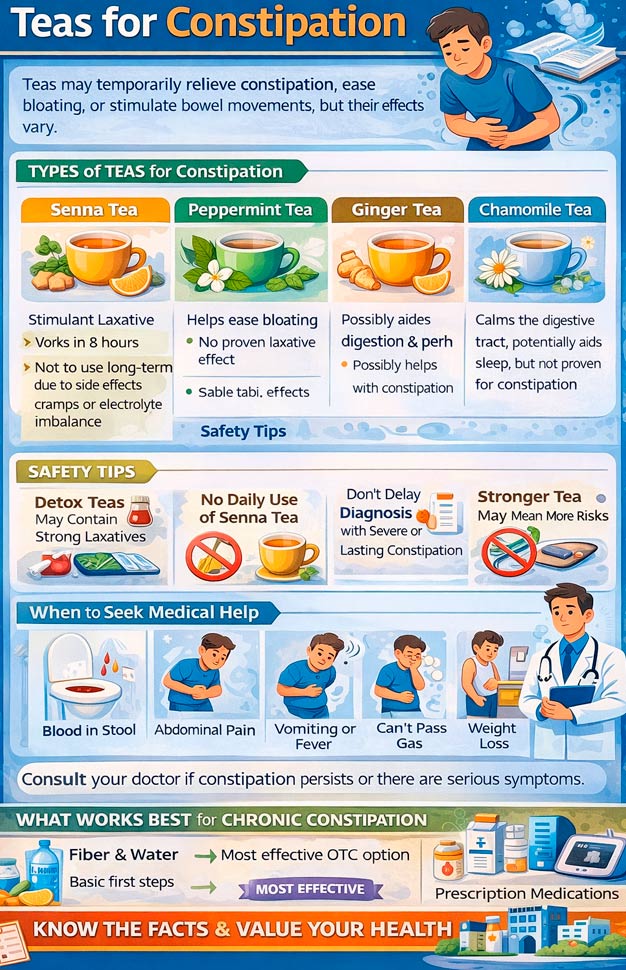
| Senna tea | Real laxative effect, but with risk of side effects |
| Detox teas and multi-component laxative mixtures | The effect is more unpredictable, the risk of overdose and adverse reactions is higher |
| Chronic constipation | Usually requires not only tea, but a complete treatment algorithm |
Sources for the table: [6]
Senna Tea: The Only Tea with a Really Noticeable Laxative Effect
Based strictly on clinical recommendations and medicinal reference books, senna is the most proven "tea" option for constipation. Senna is used as a short-term remedy for constipation and is classified as a stimulant laxative. Its action is not due to intestinal motility per se, but to stimulating colon motility. This is why senna tea is often more effective than mint, chamomile, or ginger. [7]
It's important to understand that senna is not just a folk remedy, but a fully-fledged herbal medicine. The American Gastroenterological Association and the American College of Gastroenterology recommend senna for chronic idiopathic constipation, with a conditional recommendation. Furthermore, reviews of over-the-counter therapy emphasize that senna has a strong evidence base among over-the-counter laxatives, although polyethylene glycol is generally considered a more reliable option in terms of potency and predictability of long-term effect. [8]
According to the UK National Health Service, senna is typically taken once daily before bedtime, and its effects last approximately eight hours. This is a useful practical detail for patients: drinking senna tea during the day "just in case" can result in an inconvenient and too-rapid effect in the evening or at night. Furthermore, the exact dosage in tea mixtures can be less predictable than in standardized dosage forms. [9]
The main limitation of senna is that it is not intended for long-term daily self-medication. The UK National Health Service and MedlinePlus emphasize that senna is for short-term use. Long-term use can cause diarrhea, cramps, sodium, potassium, and magnesium imbalances, and a risk of bowel dysfunction. [10]
Another important point concerns the popular idea that "if the tea is natural, it can be drunk for weeks." This is incorrect. Senna is of plant origin, but this does not automatically make it suitable for long-term use. Even the official British regulator has strengthened its warnings on stimulant laxatives, stating that dietary and behavioral measures are preferable initially, and stimulant laxatives should be used when these measures are insufficient or their effect is weak. [11]
| Question about senna | Practical answer |
|---|---|
| Does senna have a proven effect? | Yes, it is a stimulant laxative with proven effectiveness. |
| How long does it usually take for it to work? | In about 8 hours |
| Is it suitable for occasional constipation? | Yes, it may be suitable for a short period of time. |
| Is it suitable for continuous daily use without a doctor's advice? | No |
| Main risks | Cramps, diarrhea, electrolyte disturbances, addiction to constant stimulation |
Sources for the table: [12]
Mint, ginger, chamomile, fennel, and other mild teas: what to expect from them
Peppermint tea is often perceived as "tummy tea," and there's a grain of truth to this. The evidence on peppermint focuses more on the relief of cramping, pain, and general discomfort associated with functional gastrointestinal disorders, rather than treating chronic constipation per se. The National Center for Complementary and Integrative Health in the United States notes that peppermint tea appears to be safe, but this doesn't mean it's a proven laxative. [13]
In practice, this means the following: mint may be beneficial for people whose constipation is accompanied by a feeling of fullness, cramping, or severe bloating. However, it should not be expected to reliably increase bowel frequency. If a patient has chronic constipation rather than spastic discomfort, mint tea should not replace standard treatments. This conclusion stems from the fact that mint is not included in current core treatment recommendations for chronic constipation, and the evidence base for it relates primarily to other symptoms. [14]
Ginger tea occupies an intermediate position. Ginger has been shown to influence upper gastrointestinal motility and reduce nausea, and some studies have shown possible improvement in constipation in specific patient groups. However, this evidence is still too limited and inconsistent to consider ginger tea a standard treatment for chronic constipation. [15]
Chamomile tea is often perceived as a gentle and safe evening drink. The National Center for Complementary and Integrative Health considers chamomile in tea-like amounts likely safe, but there are no reliable clinical recommendations for its use specifically for constipation treatment. Thus, chamomile may be a comfortable beverage, but it is not a complete treatment strategy. [16]
The situation with fennel and multi-ingredient herbal teas is even more complex. The traditional use of fennel is widely known, especially for bloating, but high-quality data on constipation is limited and mostly concerns either small studies or mixtures of several ingredients, where it is impossible to accurately assess the contribution of each herb. Therefore, for adults with chronic constipation, such teas should be considered only as a supplemental treatment, not a primary treatment. [17]
| Tea | What can you realistically expect? |
|---|---|
| Mint | Sometimes reduces cramping and bloating, but is not considered a proven laxative |
| Ginger | May relieve nausea and have some effect on motility, but data on constipation are limited. |
| Chamomile | Generally well tolerated but lacks strong evidence for the treatment of constipation |
| Fennel | Sometimes used for gas formation, but data on constipation itself is limited |
| Herbal mixtures | The effect is often unpredictable, especially without standardization of the composition. |
Sources for the table: [18]
Which teas and habits can do more harm than good?
So-called "cleansing" and "detox" teas deserve a separate discussion. Their effects are often achieved by the same senna or other stimulating ingredients, but the dosage and composition of such mixtures are less transparent to the consumer. The problem isn't the word "detox" itself, but rather that people may drink such teas regularly, considering them almost a food product rather than a laxative. [19]
Another risk is trying to substitute tea for a full assessment of the causes of constipation. A person may drink laxative teas for weeks, temporarily achieving bowel movements, but fail to notice that medications, fiber deficiency, hypothyroidism, a poorly coordinated pelvic floor, opioid side effects, or even an organic problem in the colon could be behind it. Current guidelines for diagnosing constipation emphasize that chronic constipation requires an assessment of the underlying causes, not just the selection of a symptomatic remedy. [20]
Not all herbal laxatives are equally safe. For example, cascara, which is sometimes included in laxative mixtures, is generally well-tolerated, according to LiverTox, but at high doses and over long periods of use, it can cause clinically significant liver damage. This is an important signal for patients: herbal origin does not guarantee absolute safety. [21]
One should also be cautious about the logic that "the stronger the tea, the better the effect." For mild teas, this is usually meaningless, and for senna and other stimulating ingredients, it can actually increase the risk of cramps, diarrhea, and dehydration. This is especially undesirable for the elderly, patients with heart disease, kidney problems, and those already taking medications that affect electrolyte balance. [22]
Finally, tea should not be used as a "daily cleanse" or weight loss tool. The British regulator specifically emphasized that laxatives do not aid weight loss and that their improper use can be harmful. This is important in the context of constipation, as many people turn to laxative teas not because of true chronic constipation, but because they want to "cleanse their bowels." From a medical perspective, this is a misguided and risky approach. [23]
| What looks attractive | Why this is a bad idea |
|---|---|
| Daily "detox tea" for months | It is possible to become chronically addicted to stimulant laxatives without realizing it. |
| Increase the strength of laxative tea | Increased risk of cramps and diarrhea |
| Replace tea with examination in case of prolonged constipation | You may miss a serious reason |
| Consider herbal preparations completely safe | Some of them have toxicity and drug interactions. |
| Drink laxative teas for weight loss | This does not work as a weight control method and can be harmful. |
Sources for the table: [24]
How to safely use tea if constipation has already occurred
For occasional, uncomplicated constipation, a safe strategy begins not with a strong laxative tea, but with an assessment of daily routine, fluids, and diet. The National Institute of Diabetes and Digestive and Kidney Diseases in the United States recommends increasing fiber intake and drinking enough water and other fluids, especially if a person increases fiber intake or takes dietary fiber supplements. For adults, the recommended daily fiber intake is 22-34 grams, depending on age and gender. [25]
Against this backdrop, plain warm tea without laxatives may well be helpful, as it adds fluid and, for some people, subjectively facilitates morning bowel movements. However, it's important to understand the limits of this approach: it's a supportive habit, not a standalone treatment for chronic constipation. If there's no improvement after a few days, it's worth moving on to more proven methods rather than simply swapping one tea for another. [26]
If you're looking to use herbal tea, the most logical choice from a safety standpoint is a mild tea without a strong laxative component, such as peppermint or chamomile, when the primary goal is comfort and tolerability. If a real laxative effect is desired, senna can be used short-term, but it's best to think of it as a medicine rather than a drink for regular enjoyment. This approach better protects against underestimating the dosage and duration of use. [27]
For people with chronic constipation, standard over-the-counter remedies with a clear dosage and predictable mechanism of action are usually a more reliable option than experimenting with teas. A joint guideline from the American Gastroenterological Association and the American College of Gastroenterology strongly supports polyethylene glycol, while fiber, lactulose, senna, and magnesium have conditional recommendations. This means that senna tea has a place, but it does not occupy the top of the therapeutic hierarchy. [28]
The safest practical principle is to use mild tea as part of a drinking regimen, senna only briefly and with caution, and chronic constipation as a reason not for endlessly switching teas, but for a comprehensive treatment plan. This approach is more in line with modern recommendations than the popular idea of a "magic evening tea." [29]
| Situation | Smart tactics |
|---|---|
| Mild occasional constipation | Liquids, nutrition, exercise, soft tea as tolerated |
| A one-time, pronounced effect is needed. | Briefly possible senna |
| Constipation lasts for weeks | An assessment of the causes and more proven treatments are needed. |
| Mint or chamomile are liked and well tolerated. | Can be used as a comfort drink |
| There are doubts about the composition of the "laxative tea" | It is better not to use opaque mixtures |
Sources for the table: [30]
When tea is no longer appropriate and a medical assessment is needed
There are situations when you should put tea aside and consult a doctor. The National Institute of Diabetes and Digestive and Kidney Diseases recommends medical evaluation if constipation does not resolve with self-care or becomes persistent. It is especially important not to delay if there is rectal bleeding, blood in the stool, persistent abdominal pain, vomiting, fever, difficulty passing gas, lower back pain, or unintentional weight loss. [31]
Modern gastroenterological guidelines also highlight so-called warning signs. These include blood in the stool, anemia, weight loss, and other signs of a possible organic problem. In such circumstances, choosing a tea or over-the-counter laxative should not replace diagnostic testing. Sometimes, "protracted constipation," which a person has been treating at home for a month, turns out to be a manifestation of another illness. [32]
Particularly noteworthy are constipation that first appears after age 50, if it rapidly changes the usual bowel pattern, or if it is accompanied by severe bloating, pain, or alternating with diarrhea. Not every such case indicates a serious underlying condition, but it certainly requires a more serious approach than simply advising someone to "take some herbs." This is consistent with the general logic of modern diagnostic algorithms for constipation in adults. [33]
Secondary constipation should also be considered. It can be caused by medications, especially opioids, some antidepressants, iron supplements, calcium channel blockers, and other medications. Hypothyroidism, diabetes, neurological diseases, pelvic floor muscle dysfunction, and physical inactivity are also significant. In this context, tea may temporarily mask the problem, but not solve it. [34]
This is why a medical evaluation is necessary not only for "scary symptoms" but also when constipation has become a chronic part of life. Modern diagnostics may include a medical history, physical examination, blood tests, and sometimes a colonoscopy for alarming signs. If a bowel movement disorder is suspected, specialized functional studies are also included. At this point, the debate over whether mint or chamomile is better becomes irrelevant. [35]
| Sign | What to do |
|---|---|
| Blood in the stool or bleeding | See a doctor quickly |
| Constant abdominal pain | Don't treat with tea alone |
| Vomiting, fever, no gas | Rule out an emergency |
| Weight loss or anemia | Diagnosis of the cause is needed |
| Long-term or new constipation in an adult | An in-person assessment is required |
Sources for the table: [36]
What really works better than tea for chronic constipation?
Based on current clinical guidelines, the best results for chronic constipation are usually achieved not by a single product, but by a combination of measures. The basic approach includes dietary adjustments, adequate fluid intake, physical activity, and appropriate laxatives. The National Institute of Diabetes and Digestive and Kidney Diseases in the United States recommends increasing fiber and fluid intake, while gastroenterological guidelines further elaborate on the stages of drug therapy. [37]
Among over-the-counter (OTC) laxatives, polyethylene glycol received the strongest support in the joint American Gastroenterological Association/American College of Gastroenterology guideline. It is an osmotic laxative, not an herbal remedy, but generally outperforms laxative teas in predictability and data quality. Fiber, magnesium, lactulose, and senna are also used, but the level of certainty in their effectiveness is lower or the recommendation is weaker. [38]
If over-the-counter measures fail, guidelines recommend switching to prescription medications such as linaclotide, plecanatide, prucalopride, and others, depending on the clinical situation. This is especially important for patients who have been relying on laxative teas for years. Chronic constipation shouldn't result in a constant search for new "natural" concoctions when more reliable strategies exist. [39]
For some people, the problem isn't a lack of fluid or a "lazy bowel," but rather a dysfunction of the pelvic floor muscles. In this situation, bioactive tea won't solve the underlying problem, but specialized diagnostics and biofeedback can be significantly more effective. Expert literature on constipation and intestinal motility emphasizes the importance of assessing impaired bowel movements when standard therapy is ineffective. [40]
That's why tea's place in the modern treatment plan seems modest, but not zero. Tea can be part of a comfortable drinking regimen, senna in tea form can act as a short-term laxative, and mint and chamomile can improve symptom tolerability. But frankly, and based on current data, the foundation of chronic constipation treatment is not tea, but a systemic gastroenterological approach. [41]
| What helps with chronic constipation? | How confirmed is this? |
|---|---|
| Fiber and adequate fluids | Basic measure, supported by recommendations |
| Polyethylene glycol | One of the most proven over-the-counter options |
| Senna | It may help, but usually as a short-term or adjunctive measure. |
| Prescription medications when simple measures fail | Supported by modern guidelines |
| Pelvic floor assessment and functional diagnostics | It is necessary in some persistent cases. |
Sources for the table: [42]
FAQ
Does warm tea by itself help?
Sometimes it helps indirectly because it increases fluid volume and makes the morning bowel movement more regular. However, for chronic constipation, warm tea alone is not considered a proven treatment. [43]
What is the strongest tea for constipation?
Of all teas, senna tea is expected to have the most pronounced laxative effect, as senna is a stimulant laxative. However, for this very reason, it cannot be considered a harmless everyday drink. [44]
Can you drink senna tea every day?
This should not be done without a doctor's prescription. Long-term use of senna can lead to diarrhea, electrolyte imbalances, and decreased bowel function. [45]
Does peppermint tea cure constipation or just relieve discomfort?
More likely the latter. It may reduce cramping and bloating, but is not included in mainstream modern recommendations as a standard treatment for chronic constipation. [46]
Is ginger tea good for constipation?
The potential benefits are debated, but the evidence base is limited and does not allow ginger tea to be considered a standard therapy. It may be considered an adjunct rather than a primary treatment. [47]
Is there any point in "detox tea"?
From a medical perspective, this is a questionable idea. Often, such teas work due to stimulating components, rather than any kind of "cleansing," and can be harmful if used incorrectly. [48]
When can you no longer limit yourself to tea when you are constipated?
When there is blood in the stool, persistent abdominal pain, vomiting, fever, inability to pass gas, weight loss, or when constipation becomes prolonged and does not resolve with self-care. [49]
What usually works better than herbal teas?
For chronic constipation, a diet with sufficient fiber, adequate fluid intake, polyethylene glycol, and other standard treatments, chosen according to a modern treatment regimen, are usually more reliable. [50]
Key points from experts
Lin Chang, MD, is a professor of medicine at the University of California, Los Angeles, and an expert in gut-brain disorders, including chronic constipation. Her practical thesis for this topic can be summarized as follows: it's not the isolated symptom of "infrequent bowel movements" that needs to be treated, but rather the patient's entire clinical profile, as chronic constipation is often associated not only with diet but also with impaired motility, sensation, and quality of life. [51]
Satish S. S. Rao, MD, PhD, is a professor of medicine and chief of gastroenterology and neurogastroenterology at Augusta University; his research interests include constipation, motility disorders, and biofeedback for dyssynergic defecation. His key takeaway for practice is simple: if constipation is persistent, don't endlessly switch supplements and teas, as some patients require evaluation for pelvic floor and functional disorders. [52]
William D. Chey, MD, is a professor of gastroenterology and nutrition and chief of the Division of Gastroenterology and Hepatology at the University of Michigan; his work focuses on functional bowel disorders and their treatment. His practical thesis for patients with constipation is that "natural" does not equal proven, and lasting results are more often achieved when diet, fluid, and medication are selected according to a clear algorithm rather than based on advertising for individual drinks. [53]