
Medical expert of the article

New publications
Peels for psoriasis: can they be used, which ones are dangerous, and how to safely remove scales
Last updated: 04.04.2026

All iLive content is medically reviewed or fact checked to ensure as much factual accuracy as possible.
We have strict sourcing guidelines and only link to reputable media sites, academic research institutions and, whenever possible, medically peer reviewed studies. Note that the numbers in parentheses ([1], [2], etc.) are clickable links to these studies.
If you feel that any of our content is inaccurate, out-of-date, or otherwise questionable, please select it and press Ctrl + Enter.
Psoriasis is a chronic immune-mediated inflammatory skin disease, and modern therapy treats it not with cosmetic procedures, but with topical medications, phototherapy, systemic medications, and biological agents. Current psoriasis guidelines do not include peels as a standard, stand-alone treatment method. [1]
The main confusion begins with the word "peeling" itself. In cosmetology, it's more often understood as chemical damage to the superficial layers of the skin to renew the surface. In dermatology, for psoriasis, what patients sometimes call peeling often refers to something completely different: gentle keratolytic softening of the scales to reduce flaking and facilitate the penetration of the treatment into the plaque. [2]
Salicylic acid is indeed classified as an exfoliant. The National Psoriasis Foundation explicitly calls it a keratolytic and "scale remover," and the American Academy of Dermatology writes that it helps reduce scale and soften plaques in psoriasis. However, this does not make cosmetic peels a standard treatment for psoriasis. [3]
From a practical standpoint, it's more accurate to describe "controlled removal of thick scales as part of a treatment regimen" rather than "peeling for psoriasis." This approach can be useful on the scalp, very thick plaques, and the palms and soles, but it almost always works as a complement to primary treatment, not as a replacement for it. [4]
The bottom line for the patient is very simple. Cosmetic peels and medical keratolytic treatments are not the same thing. In psoriasis, the focus should not be on "salon skin renewal," but on safe scale reduction within the framework of an evidence-based treatment plan. [5]
Table 1. What is the difference between cosmetic peels and medical keratolytic treatment for psoriasis? [6]
| Approach | What is this? | Place for psoriasis |
|---|---|---|
| Cosmetic chemical peeling | Controlled chemical skin damage for surface renewal | Not a standard treatment for psoriasis |
| Homemade scrubs and harsh rubbing | Mechanical trauma and peeling of scales | Undesirable, may worsen the course of the disease |
| Keratolytics | Softening and reducing scales with medications | Acceptable as an auxiliary measure |
| Emollients | Softening, moisturizing, barrier restoration | Useful as part of regular care |
| Primary therapy | Anti-inflammatory treatment for psoriasis | Basic and priority approach |
Why aggressive exfoliation can make the condition worse
The Koebner phenomenon is very important for psoriasis. This is a situation in which new psoriatic lesions appear on areas of the skin following injury or irritation. The American Academy of Dermatology clearly states that psoriasis can be triggered or aggravated by skin trauma. [7]
A review of the Koebner phenomenon indicates that new lesions can arise after trauma to healthy skin, and the phenomenon itself is observed in approximately 25%-30% of patients. In experimental skin damage, even relatively mild impacts, including superficial trauma and biopsy methods, could provoke new lesions in some patients. [8]
This explains why harsh scrubs, rubbing with a washcloth, scraping off scales with fingernails, and rough mechanical cleansing so often worsen rather than improve. Using the scalp as an example, the American Academy of Dermatology specifically notes that friction, vigorous washing, and scratching can aggravate existing psoriasis. [9]
Chemical peels are also, at their core, controlled skin damage. DermNet describes them as the application of chemicals that "burn" damaged cells, and StatPearls lists psoriasis as a contraindication or serious limitation for medium and deep chemical peels. [10]
There are also clinical signs of direct risk. A publication in the Journal of the American Academy of Dermatology described how, following a medium-depth chemical peel, facial psoriasis, not apparent before the procedure, manifested as lingering redness. This does not mean that any superficial acid contact will necessarily trigger a flare-up, but it does indicate that aggressive acid exposure can trigger or exacerbate the psoriatic process. [11]
Table 2. Why traumatic peeling is dangerous for psoriasis. [12]
| Mechanism | What's happening |
|---|---|
| Skin trauma | May provoke new outbreaks |
| Harsh rubbing and scratching | Increases inflammation and flaking |
| Deep chemical action | Creates controlled skin damage |
| Peeling off scales | May cause bleeding and a new skin reaction |
| Work on active plaque | Increases the risk of irritation and exacerbation |
When is "gentle exfoliation" still appropriate?
There's no need to completely abandon the idea of reducing flaking. In modern practice, this is done not with aggressive peels, but with emollients and keratolytics. The professional reference book MSD Manual indicates that emollients reduce flaking, help restore the skin barrier, and improve comfort, although they do not change the underlying cause of the condition. [13]
Salicylic acid is the most well-known keratolytic agent for psoriasis. The American Academy of Dermatology writes that it helps reduce scale and soften plaques, and a review of topical therapy emphasizes that it is particularly useful in combination with topical corticosteroids or calcineurin inhibitors because it improves the penetration of the active ingredient. [14]
According to a review of topical therapy, a combination of a topical corticosteroid and salicylic acid is particularly useful for dense, thick plaques, as well as for the palms, soles, and scalp. It also states that the working concentrations of salicylic acid in such regimens are typically 2%-6%. [15]
In addition to salicylic acid, urea, lactic acid, fruit acids, and propylene glycol are used as keratolytics. DermNet notes that urea and salicylic acid can reduce scaling, but can cause burning and irritation, especially if the skin is already cracked, scratched, or eroded. [16]
It's also important to understand the limitations. Salicylic acid is not recommended for use with vitamin D analogs because the acidic pH inactivates these medications. It should not be applied before phototherapy because it blocks ultraviolet radiation, and when applied to large areas of skin, especially more than 20% of the body surface, the risk of toxicity increases. Additional caution is required in patients with liver and kidney disease, children, and during pregnancy. [17]
This is why "peeling" for psoriasis, if it's even possible, isn't a salon-style procedure that covers the entire surface, but a limited, deliberate, and usually temporary application of a keratolytic to specific areas with dense scales. The more active the inflammation and the thinner the skin in the affected area, the less room there is for independent action. [18]
Table 3. Which products can actually act as a controlled “peeling” for psoriasis. [19]
| Means | The main task | Restrictions |
|---|---|---|
| Emollients | Soften skin and reduce dryness and flaking | They do not treat inflammation as such. |
| Salicylic acid | Softens and removes scales | Risk of irritation and toxicity over large areas |
| Urea | Softens and reduces hyperkeratosis | May sting on cracks |
| Lactic acid | Mild keratolytic effect | Irritant reaction may occur. |
| Topical corticosteroid in combination with a keratolytic | Treats inflammation and facilitates drug penetration | The correct regime and selection of the zone are needed |
Where mistakes are most often made
The scalp is one of the few areas where patients particularly often want to "exfoliate everything at once." The American Academy of Dermatology writes that for dense scalp lesions, a salicylic acid product can help soften stubborn patches, but also emphasizes that washing should be done gently, without rubbing, aggressively brushing, or picking at the flakes. [20]
The face, skin folds, and genital area are a different story entirely. The skin here is thinner and more sensitive, making irritation more likely. A review of topical psoriasis therapy explicitly states that salicylic acid should be avoided on the genitals, mucous membranes, and around the eyes, while modern anti-inflammatory medications for sensitive areas are selected according to a completely different logic. [21]
The palms and soles may indeed tolerate keratolytic agents better than the face or folds because the skin there is thicker. However, it is precisely in these areas that patients are more likely to overuse the concentration, exposure time, and frequency of application. This is dangerous because even on thick skin, salicylic acid can cause systemic toxicity when applied over large areas and at high concentrations. [22]
A particular mistake is applying rules from cosmetology to psoriasis. What works for photoaging, post-acne, or uneven skin texture isn't necessarily suitable for an immune-inflammatory disease with Koebner's phenomenon. Chemical peels, especially medium and deep ones, require a doctor's evaluation even in people without psoriasis, and with psoriasis, the risk of making the wrong decision is higher. [23]
Finally, trying to "speed up the result" with several methods at once is very dangerous: first an acid, then harsh friction, then an active cream on irritated skin. This approach often disrupts the barrier, increases the burning sensation, and creates a new cycle of inflammation. With psoriasis, precision, rather than force, is more effective. [24]
Table 4. What are the most common mistakes with peels for psoriasis? [25]
| Error | Why is it dangerous? |
|---|---|
| Salon chemical peeling for active areas | May increase inflammation and reveal psoriasis in new areas |
| A hard scrub or washcloth | Increases injury and the risk of Koebner phenomenon |
| Scratching off scales with nails | Provokes bleeding and new elements |
| Application of acids to the face, genitals, mucous membranes | High risk of irritation |
| Use over a large area | Risk of systemic absorption, especially for salicylic acid |
| Combination with vitamin D analogues without interval | Decreased effectiveness of therapy |
What does a sensible and safe tactic look like?
The first step in treating psoriatic plaque is not to remove the scale at any cost, but to calm the inflammation. Therefore, topical treatments remain the mainstay, with keratolytics added only when the dense layer of scale actually interferes with the medication's effectiveness or significantly worsens patient comfort. [26]
Daily care is also important. MSD Manual recommends using emollients, especially thicker forms, regularly and especially after bathing, as they reduce flaking, support the skin barrier, and improve skin tolerability. Sometimes, proper moisturizing alone significantly reduces the need for exfoliation. [27]
If the scales are dense and interfere with treatment, it's wiser to use a gentle, scaled-up approach. First, soften the scales with an emollient or prescribed keratolytic in a limited area, then gently rinse without scraping, followed by the main medication. For the scalp, the American Academy of Dermatology specifically recommends gentle, rather than aggressive, skin treatment. [28]
Self-medication is especially undesirable if the lesion is on the face, in folds, or in the genital area, if the skin is cracked, bleeding, or oozing, or if the lesion covers a large area. Additional caution is necessary for children, during pregnancy, with liver or kidney disease, and for those undergoing phototherapy or complex topical regimens. [29]
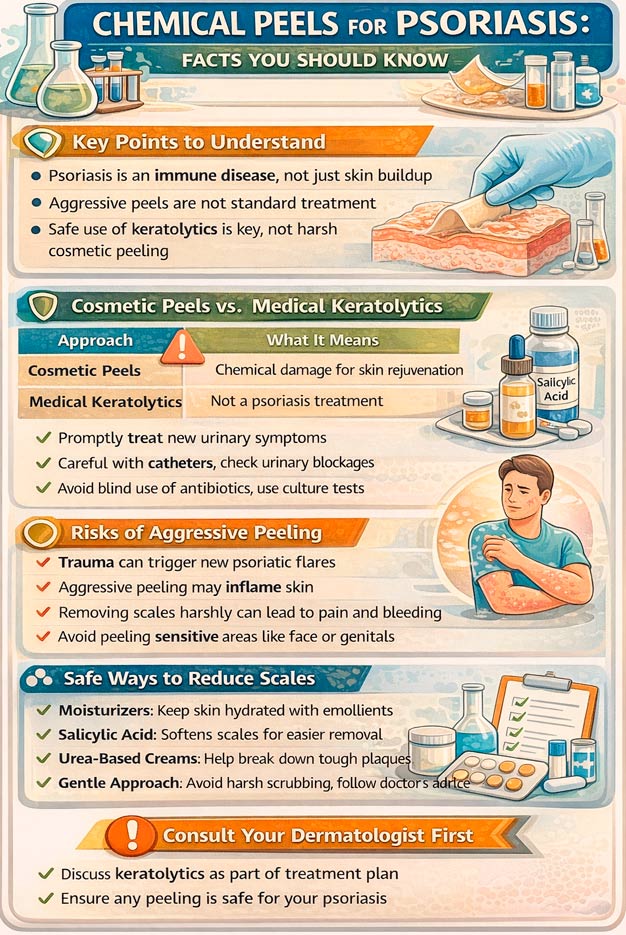
The main conclusion for 2026 is this: peels for psoriasis are not a stand-alone treatment method or a safe, universal cosmetic procedure. Rather than aggressive "peeling" in the everyday sense, we recommend limited and thoughtful use of keratolytics as an adjunct to therapy. The more active the inflammation, the more careful any attempt to "scrape" should be. [30]
Table 5. Practical algorithm for a patient with psoriasis and dense scales. [31]
| Situation | The most sensible tactic |
|---|---|
| Light peeling without a dense crust | Emollient and basic treatment |
| Thick scales on the head | Gentle shampoo and prescribed scale softener |
| Thick plaques on the body, palms or soles | A limited course of keratolytic under the control of the treatment regimen |
| Face, folds, genitals | Don't experiment with acids without consulting a dermatologist. |
| Cracks, erosions, bleeding | First, calm the inflammation and restore the barrier. |
| Desire to have a salon peeling | Discuss this with a dermatologist first. |
FAQ. Frequently Asked Questions
Is it possible to undergo a chemical peel if psoriasis is currently "almost dormant"?
Even in this situation, the decision must be made very cautiously. Medium and deep chemical peels are considered procedures that involve significant skin trauma, and psoriasis is listed among the contraindications or serious limitations for such peels. [32]
Is salicylic acid helpful for psoriasis?
Yes, but not as a salon peel, but as a keratolytic. It helps soften and reduce scale, especially on dense plaques and on the scalp, and is most often used in conjunction with other topical treatments. [33]
Can I simply scrub my skin to remove the silvery flakes?
No, that's a bad idea. Friction, scratching, and mechanical trauma can worsen psoriasis and perpetuate the Koebner phenomenon. [34]
What's better for thick scales—acids or moisturizing?
Proper moisturizing is usually the first step. Emollients reduce dryness and flaking, and keratolytics are added only when the scales are truly interfering with treatment or are very thick. [35]
Can salicylic acid be applied to the face and genital area?
It's not recommended without consulting a doctor. It's significantly less suitable for sensitive areas, and reviews specifically state that it should be avoided on the genitals, mucous membranes, and around the eyes. [36]
Is it true that salicylic acid should not be mixed with vitamin D products?
Yes. An acidic environment inactivates vitamin D analogs, so these products should not be applied together in a mixture. [37]
Why does exfoliation sometimes only make my skin redder?
Because removing scales doesn't always mean the inflammation is improving. Sometimes, after the flaking layer has thinned, the inflamed plaque itself simply becomes more visible, and if overexposed, irritation can also occur. [38]
When should you immediately stop any peels and see a doctor?
If the skin is cracking, bleeding, oozing, or is very painful, if the lesion is spreading rapidly, if it's on the face or in the genital area, or if attempts to "cleanse the skin" only increase the burning and redness. In these situations, the priority is to assess the disease activity and adjust treatment. [39]
Key points from experts
Below are not direct quotes, but practical conclusions that are consistent with modern guidelines and the work of leading psoriasis specialists.
April W. Armstrong, MD, MPH, is a professor and chief of dermatology at the University of California, Los Angeles. Her official profile highlights her international expertise in inflammatory skin diseases, including psoriasis. The practical takeaway for peels is that inflammation control and evidence-based topical therapy should be prioritized over aggressive cosmetic procedures. [40]
Joel M. Gelfand, MD, MS, CE, is a professor of dermatology and epidemiology and medical director of the Psoriasis and Phototherapy Center at the University of Pennsylvania. His background emphasizes his expertise in psoriasis, clinical epidemiology, and treatment safety. For peels, this translates into a simple clinical principle: interventions that create skin trauma without proven benefit to the disease should be evaluated with particular scrutiny. [41]
Alice B. Gottlieb, MD, PhD, is the Director of Clinical Research at the University of Texas Southwestern Medical Center. Her profile highlights her pioneering contributions to the development of immunobiological therapy for psoriasis. This leads to an important practical thesis: modern psoriasis therapy is evolving toward precision anti-inflammatory treatment rather than cosmetically damaging the skin for the sake of temporary scaling. [42]