
Medical expert of the article

New publications
Exercises for an umbilical hernia: what you can and can't do, and when surgery is needed
Last updated: 04.04.2026

All iLive content is medically reviewed or fact checked to ensure as much factual accuracy as possible.
We have strict sourcing guidelines and only link to reputable media sites, academic research institutions and, whenever possible, medically peer reviewed studies. Note that the numbers in parentheses ([1], [2], etc.) are clickable links to these studies.
If you feel that any of our content is inaccurate, out-of-date, or otherwise questionable, please select it and press Ctrl + Enter.
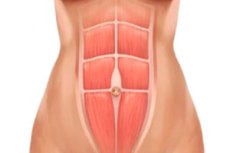
An umbilical hernia in an adult isn't simply a sign of weak abdominal muscles, but rather a defect in the abdominal wall through which fat or a loop of intestine protrudes. Therefore, exercise can't "close the hole," just as muscle training can't mend torn fascia. For this reason, the American College of Surgeons explicitly states that the only way to repair a hernia is surgery, and the UK's National Health Service emphasizes that in adults, umbilical hernias usually don't resolve on their own. [1]
This leads to an important, yet often misunderstood, conclusion. Exercise does not correct the defect itself, but physical activity remains clinically significant because it impacts body weight, overall endurance, exercise tolerance, breathing, constipation prevention, and readiness for surgery. A review by the Cleveland Clinic and a publication on preoperative optimization emphasize that fear of movement in patients with hernias often leads to deconditioning, which in turn impairs overall well-being and recovery. [2]
Current literature increasingly views exercise not as "conservative hernia treatment" but as part of a broader patient management strategy. A 2025 systematic review and meta-analysis of abdominal wall hernias found that physical activity and exercise programs in the available studies were associated with improved quality of life and some clinical outcomes, but the authors themselves emphasized the limited number of studies and heterogeneity of programs. [3]
This is especially important for patients who don't yet have an urgent need for surgery or who are preparing for a planned procedure. A review from the Cleveland Clinic clearly states that, in the absence of significant pain and complications, many people don't need to completely abstain from activity, but should avoid excessive straining and discuss the type of activity with their doctor. In other words, the modern approach isn't to "lie still," but to move sensibly and without provoking symptoms. [4]
It's also important to remember that exercise recommendations for umbilical hernia in adults are based not on a vast number of studies specifically on this hernia, but largely on data on ventral hernias and preoperative preparation of patients with abdominal wall defects. Therefore, the honest medical answer is: exercise can be useful as a supportive and preparatory measure, but it does not replace surgical treatment and does not eliminate the risk of strangulation. [5]
Table 1. What exercises can and cannot do for an umbilical hernia
| Question | The real answer |
|---|---|
| Can exercise close an abdominal wall defect? | No |
| Can exercise reduce detraining? | Yes |
| Can exercise help manage weight? | Yes |
| Can exercise completely eliminate the risk of impingement? | No |
| Are exercises helpful before planned surgery? | Often yes, if they don't cause pain |
| Is it possible to replace surgery with exercise alone? | No |
Sources for the table: [6]
When is physical activity acceptable before surgery?
For a small, reducible, and non-troubling umbilical hernia in an adult, a watchful waiting approach is acceptable. StatPearls notes that observation is often the preferred treatment for asymptomatic hernias, but the patient should be advised of the signs of strangulation and incarceration, as well as given advice on safe lifting. The American College of Surgeons also notes that very small, reducible, and non-troubling hernias can sometimes be observed, although the risk of complications remains. [7]
This means that physical activity itself is not automatically prohibited. A Cleveland Clinic review states that if you have a pre-existing hernia, the appropriateness of exercise depends on the severity of the condition, but in general, it's best to avoid anything too strenuous or that requires significant straining. It also emphasizes that low-impact activities such as walking, swimming, and cycling are generally considered safer options, although these should still be discussed with your doctor beforehand. [8]
A practical guideline for everyday life is very simple: pain in the hernia area is a bad sign during exercise. The Baylor College of Medicine booklet on pre- and post-operative activity clearly states that regular physical activity can be continued before surgery if it does not cause pain in the hernia area; if it does cause pain, it is better to switch to a more gentle regimen, primarily walking. This principle also works well in everyday practice. [9]
Factors that increase intra-abdominal pressure must be considered separately. The Cleveland Clinic reminds that not only heavy weights but also coughing, sneezing, constipation, and straining increase intra-abdominal pressure and stress the weak point of the abdominal wall. Therefore, safe exercise with an umbilical hernia involves not only choosing the right exercise but also controlling your breathing, avoiding jerking movements, and preventing constipation. [10]
Physical activity ceases to be "normal" and requires urgent reassessment if the hernia has become dense, painful, no longer reducible, enlarged, reddened, or if nausea, vomiting, gas, or bowel movements develop. In these cases, it's no longer a question of exercise, but of possible strangulation, requiring urgent surgical intervention. [11]
Table 2. When it is usually possible to move, and when it is no longer worth experimenting
| Situation | Tactics |
|---|---|
| Small reducible hernia without pain | Gentle activity is often acceptable |
| A hernia only hurts under very heavy loads. | Review the type of load and discuss it with the surgeon |
| Any exercise causes pain in the navel area | Stop the exercise |
| The hernia stopped resetting | Urgent in-person assessment |
| Nausea, vomiting, redness, and bloating appeared. | Urgent Care |
| There are doubts whether the load is suitable | Discuss with your doctor first |
Sources for the table: [12]
What exercises are most often considered the most gentle?
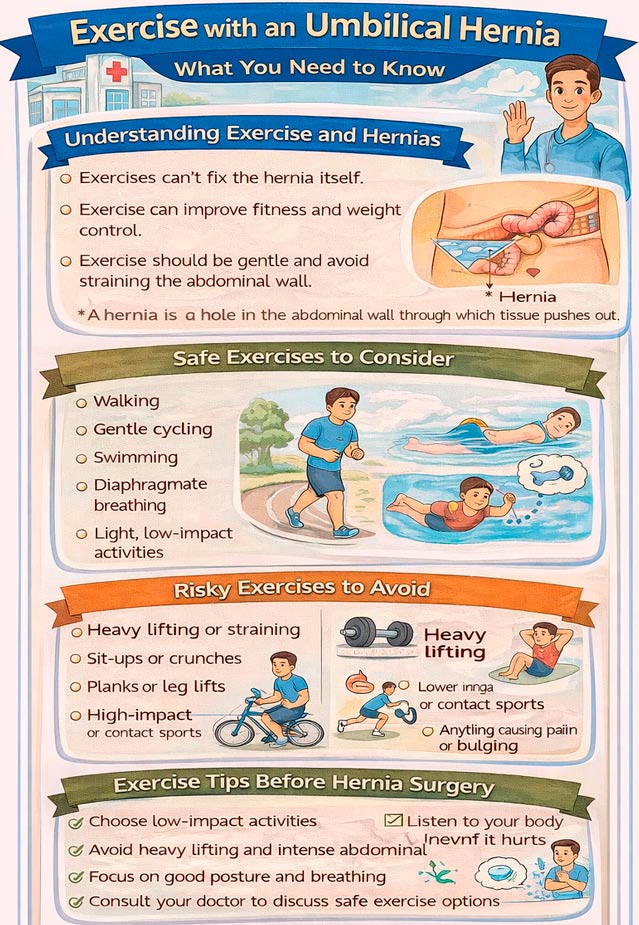
Walking remains the most universal and best-tolerated form of exercise for umbilical hernia. Both the Cleveland Clinic and the Baylor College of Medicine rehabilitation booklet emphasize it: if your usual exercise causes pain or if there's no regular program, walking is the most obvious entry point. This is good news for the patient, as it doesn't require special techniques, equipment, or advanced athletic training. [13]
A second, relatively gentle option is moderate, low-impact aerobic exercise, such as gentle swimming or stationary cycling without vigorous strength training. The Cleveland Clinic considers swimming and cycling to be typically safer options for people with hernias, provided such activities don't involve significant straining and are discussed with a doctor beforehand. A moderate, rather than competitive, regimen is important here. [14]
The third important group is breathing exercises and core control exercises that avoid a sharp increase in intra-abdominal pressure. A Baylor College of Medicine booklet describes diaphragmatic breathing, sniff and huff, maintaining correct posture, and the log-roll technique as elements of safe postoperative and perioperative behavior. Although these exercises do not "cure" the hernia, they help you move more carefully and avoid creating unnecessary abdominal tension. [15]
Hypopressive exercises deserve special mention. A 2025 pilot study on preoperative preparation for abdominal wall surgery used cardiovascular training, muscle strengthening, breathing exercises, and hypopressive abdominal exercises. The authors suggested that such movements may be more suitable for patients with ventral hernias because they enhance muscle work with a smaller increase in intra-abdominal pressure. However, the authors themselves emphasize that data on these exercises is still limited. [16]
Therefore, the most cautious and scientifically sound pre-operative regimen is as follows: walking, gentle cardio, breathing exercises, posture work, and, if you have access to a rehabilitation specialist, an individually tailored, pain- and strain-free training program. However, promises to "reduce a hernia with abdominal exercises" are not supported by modern literature. [17]
Table 3. Exercises that are most often considered the most gentle
| Type of activity | Why is it chosen more often? |
|---|---|
| Walking | Simple, accessible, does not require much straining |
| A gentle exercise bike or a non-jerking bike | Low impact load with good tolerance |
| Smooth sailing | Low-impact aerobic activity |
| Diaphragmatic breathing | Helps avoid excess abdominal tension |
| Techniques for carefully standing up and turning over | Reduces sudden stress on the abdominal wall |
| Individual rehabilitation program | Allows you to select a load based on symptoms |
Sources for the table: [18]
What exercises and movements are usually avoided for an umbilical hernia?
The most common mistake is trying to "work out" a hernia with classic abdominal exercises. The Cleveland Clinic explicitly classifies exercises that place intense strain or stretch on the abdominal muscles as undesirable. Therefore, sharp crunches, heavy sit-ups, aggressive planks through pain, and other exercises that place significant abdominal pressure are hardly a good choice for an active umbilical hernia. [19]
The second type of unwanted load is heavy strength work involving holding your breath and straining. According to the Cleveland Clinic, the problem isn't just with the weight itself, but also with how it's lifted: jerking, losing technique, lifting with your back, and holding your breath all increase abdominal pressure and stress on the weak area. This is especially true for heavy squats, deadlifts, overhead presses, and any attempts to push yourself to the max. [20]
The third risk block is high-impact and contact activities. The Cleveland Clinic advises avoiding high-impact exercises and full-contact sports, as sudden jolts, blows, and sudden surges of force create unfavorable conditions for an existing defect. For an umbilical hernia, this is especially important if the bulge becomes tender or easily enlarges with strain. [21]
It's worth mentioning everyday activities, which patients don't always consider "exercise." Lifting heavy bags, carrying a child at arm's length, straining for long periods on the toilet, persistent coughing, and even improperly getting out of bed can have the same adverse effects on the abdominal wall as a poor workout. In this sense, safe behavior for a hernia involves not only choosing a sport but also how to perform normal daily activities. [22]
Therefore, the general principle is very strict, yet simple: anything that causes bulging, pain, a feeling of fullness, the need to strain, or hold your breath should be considered inappropriate until assessed in person by a specialist. An exercise doesn't have to be professionally strenuous to be harmful for a specific umbilical hernia. Here, being observant of your own symptoms is more helpful than heroism. [23]
Table 4. What is most often considered unwanted loads?
| Type of load | Why are they being careful with him? |
|---|---|
| Crunches, sit-ups, and intense abdominal exercises | Increases intra-abdominal pressure |
| Heavy barbell and maximum strength training | Requires straining and holding of breath |
| Jumping and high-impact training | They produce sharp peaks in load |
| Contact sports | There is a risk of impact and sudden stress |
| Any load through pain | May indicate a worsening condition |
| Household lifting of heavy objects while holding your breath | Loads the hernial orifice in the same way as training |
Sources for the table: [24]
What changes with exercise after umbilical hernia surgery?
After surgery, the emphasis shifts: exercises are no longer discussed in relation to the defect itself, but become part of the recovery process after abdominal wall plastic surgery. Here, too, there is no single global standard for all techniques, but modern reviews and expert surveys agree on one thing: after uncomplicated surgery, early mobilization is beneficial, and excessively prolonged restrictions on any movement are likely excessive. [25]
In a 2021 review of postoperative activity after abdominal and hernia surgery, the authors concluded that there is no reason to prohibit immediate mobilization, and for laparoscopic surgery in uncomplicated cases, limiting heavy physical activity for up to 2 weeks seemed sufficient; for open ventral and abdominal surgery, an interval of up to 4 weeks was more common. The authors explicitly emphasized that the evidence base remains limited and the recommendations are often overly strict. [26]
However, local postoperative protocols are often significantly more conservative. A Baylor College of Medicine booklet recommends starting short walks on the day of surgery, gradually increasing the duration based on pain, fatigue, and swelling. It also advises avoiding exercises that actively load the abdominal muscles for six weeks, as well as lifting, pulling, or pushing anything heavier than approximately 10 pounds, unless otherwise directed by the surgeon. This is a good example of how practices vary across centers. [27]
The same Baylor protocol also highlights the exercises typically considered essential postoperatively: walking, diaphragmatic breathing, careful turning and standing techniques, and maintaining good posture. In other words, early recovery after umbilical hernia repair is not focused on abdominal exercises and fitness, but on safe movement, preventing congestion, and gradually returning to daily activities. [28]
Therefore, after surgery, the best plan almost always looks like this: walking and gentle movement in the first few days, then gradually increasing normal activity, and returning to heavier weight-bearing activities and core exercises only according to the surgeon's recommendations, as the timing depends on the approach, mesh, defect size, and the postoperative course. Modern articles provide guidelines, but the final decision still rests with the surgical team. [29]
Table 5. What is usually recommended after surgery
| Period | What is allowed more often? |
|---|---|
| Day of surgery or first day | Short walks, standing up, gentle movement |
| The first days | Walking with gradual increase in time |
| Early recovery period | Breathing exercises, gentle turns and standing up |
| After laparoscopic surgery without complications | Limitation of heavy loads often for about 2 weeks |
| After open plastic surgery without complications | Limitation of heavy loads often for about 4 weeks |
| Core specific exercises and weight training | Only after the surgeon's permission |
Sources for the table: [30]
When to stop exercising and see a doctor immediately
If severe, persistent pain develops during or after exercise against the background of an existing umbilical hernia, this is not a symptom to be tolerated. The American College of Surgeons warns that if the intestine becomes trapped in the hernial sac, sudden pain and vomiting occur, requiring emergency surgery. For someone exercising at home, this means: sharp pain after exercise is a reason to stop and not continue the workout. [31]
Another dangerous sign is that the hernia has become incapable of reduction. If the bulge previously diminished when lying down or with gentle pressure, but has now become hard and remains external, it's no longer a question of exercise selection, but a suspicion of strangulation. The National Health Service and the American College of Surgeons consider this situation an indication for urgent evaluation, especially if accompanied by nausea, vomiting, or skin discoloration. [32]
Vomiting, severe abdominal distension, and the inability to pass gas or stool are also considered alarming symptoms. The National Health Service explicitly states that the combination of an umbilical hernia with severe pain, vomiting, increasing swelling, or the inability to fart or pass stool requires an emergency call. This may indicate intestinal obstruction or strangulation. [33]
After surgery, indications for contacting the surgeon include increasing rather than decreasing pain, chills, high fever, foul-smelling or increasing wound discharge, and the absence of bowel movements for several days, accompanied by poor health. The American College of Surgeons lists these symptoms as important postoperative warning signs. Bandaging, exercise, or home treatment are secondary in this situation. [34]
That's why a safe strategy for umbilical hernia always revolves around a simple rule: activity is permissible only as long as it doesn't worsen symptoms or mask a complication. As soon as pain, non-reducibility, vomiting, redness, or a significant deterioration in general condition become a major concern, discussions about exercise should be discontinued and a medical evaluation should be considered. [35]
Table 6. Red flags during loading and after surgery
| Sign | What to do |
|---|---|
| Sharp or increasing pain in the hernia area | Stop the load and seek immediate evaluation. |
| The hernia stopped resetting | See a surgeon immediately |
| Nausea and vomiting | Rule out infringement or obstruction |
| Redness or discoloration of the skin | Urgent in-person assistance needed |
| No gas or stool, bloating is increasing | Urgent assessment |
| After surgery, the temperature rose or the discharge from the wound increased. | Contact a surgeon |
Sources for the table: [36]
FAQ
Can exercise correct an umbilical hernia in adults?
No. Exercises do not close the abdominal wall defect. Surgery remains the only way to permanently correct a hernia in adults. [37]
What exercises are generally considered the safest for an umbilical hernia?
Most commonly, these include walking, gentle low-impact activity, gentle swimming or cycling without straining, and breathing exercises. However, even these options are best discussed with a doctor if the hernia is already causing symptoms. [38]
Is it possible to do abdominal exercises with an umbilical hernia?
This is generally not recommended. Intense abdominal exercises and anything that causes noticeable straining are considered undesirable. [39]
If the hernia doesn't hurt, should I completely give up exercise?
Not necessarily. For a small, reducible hernia, completely eliminating exercise isn't necessary, but the activity should be gentle and not cause pain, increased bulge, or straining. [40]
Are specific rehabilitation programs before surgery helpful?
Limited evidence suggests that they may improve physical fitness and some short-term outcomes, but standardized, universal programs are lacking, and the evidence base remains mixed. [41]
What is the first thing allowed after surgery?
Typically, the first things allowed are standing, walking, and breathing exercises. The timeframe for returning to heavy lifting and core exercises depends on the type of surgery and the surgeon's instructions. [42]
How soon after surgery can you return to strength training?
There is no universal time frame. Reviews and expert surveys often cite approximately 2 weeks after laparoscopy and approximately 4 weeks after open surgery for heavy loads in uncomplicated cases, but the surgeon should provide a specific plan. Some local guidelines recommend longer restrictions. [43]
When should you stop exercising immediately?
If severe pain develops, the hernia becomes difficult to reduce, nausea or vomiting occurs, the skin over the hernia changes color, or there is no gas or stool passage. These symptoms require immediate medical attention. [44]
Key points from experts
Nadja A. Henriksen, MD, PhD, FEBS-AWS, is a staff specialist and associate professor at the University of Copenhagen, a consulting surgeon at the Digestive Disease Center, Bispebjerg Hospital, and vice president of the Danish Hernia Database. Her hernia training is important for a general understanding of umbilical hernia management: exercises are not a substitute for repair, and decisions regarding follow-up, timing of surgery, and rehabilitation should be based on symptoms, defect size, and risk of complications. [45]
Adita Prabhu, MD, a general surgeon at Cleveland Clinic Main Campus, is a fellowship-trained surgeon in minimally invasive surgery and abdominal wall reconstruction, with a special interest in abdominal wall reconstruction and mesh-related complications. Her practical advice is straightforward: if a hernia is present, it's best to choose low-impact activities and avoid heavy straining, and anything that causes pain, heavy straining, or abdominal work should be considered a no-no until an in-person consultation. [46]
William W. Hope, MD, is an associate professor of surgery at the University of North Carolina at Chapel Hill, program director for the New Hanover Regional Medical Center Residency Program, and past president of the Americas Hernia Society. His professional position reflects the modern hernia approach: postoperative return to activity and treatment options should be personalized, not based on universal prohibitions or fashionable but not always necessary technologies. [47]