
Medical expert of the article

New publications
Ovulation test: principle of operation, sensitivity
Last reviewed: 05.07.2025

All iLive content is medically reviewed or fact checked to ensure as much factual accuracy as possible.
We have strict sourcing guidelines and only link to reputable media sites, academic research institutions and, whenever possible, medically peer reviewed studies. Note that the numbers in parentheses ([1], [2], etc.) are clickable links to these studies.
If you feel that any of our content is inaccurate, out-of-date, or otherwise questionable, please select it and press Ctrl + Enter.
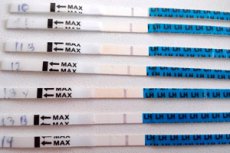
Ovulation is considered the main stage of menstruation, during which the maximum probability of fertilization occurs. The date of ovulation is important from the point of view of family planning, since a couple trying to have a child must clearly know the period when this phenomenon occurs. Ovulation means maximum physical readiness for conception. Today, it is not difficult to determine the exact date; an ovulation test has been created to help - a specially developed test system that makes it possible to determine the exact time of the egg leaving the ovary. This means full maturity. The principle of the test is based on capturing the concentration of hormones, the level of which changes significantly during this period. Using tests, you can significantly increase the chances of conceiving a child, since precise knowledge of the time of ovulation makes it possible to have sexual intercourse precisely during this period.
Sensitivity of ovulation tests
Considered high. The tests are based on the fact that they can determine the concentration of lithinizing hormone at any given time. This is the hormone responsible for the possibility of fertilization. Its concentration increases sharply when it is planned to enter the fallopian tubes, where further fertilization occurs. During stimulation or family planning, the doctor determines with the help of ultrasound how mature the follicle is. Reaching a size of approximately 18-20 mm indicates that it is acquiring the ability to ovulate. Then, at home, the doctor recommends that the woman undergo regular testing. Further results will be obtained that will accurately indicate the time of the egg's release. In order to increase accuracy, it is better to track the indicators dynamically.
Can an ovulation test be wrong?
Unfortunately, there is also a risk of errors and inaccuracies. This is due to the mechanism of the test. It detects only the change in the concentration of LH, which rises sharply precisely in connection with ovulation. But due to various reasons, ovulation may not occur.
In addition, a sharp surge of the hormone also occurs due to various pathologies of the reproductive system, in some physiological and functional conditions. An increase in the level of LH can be facilitated by exhaustion of the ovaries, disruption of normal hormonal metabolism and nervous processes in the body. Even renal failure can dramatically distort the results. Many women experience such surges during the postmenopausal period.
Such changes can be constant and variable. Many such changes occur after a woman suddenly stops taking hormonal drugs. Even a change in diet (abrupt) can affect the hormone level. For example, if a person suddenly decides to become a raw foodist, or switches to vegetarianism. This is due to the fact that plant foods contain a large number of phytohormones, which also affect the general emotional background of a person.
The error also occurs under the influence of hormonal failure, which is not caused by a surge in LH, but is associated with other indicators. Thus, LH at the molecular level has a structural identity with progesterone, which is produced during pregnancy. A certain level of similarity exists between other hormones, mainly of glycoprotein origin: hCG, FSH, TSH. They are also produced, cross-reactions occur, which are reflected as false positive results. Such a situation occurs in cases where a woman was deliberately administered hormonal drugs that artificially stimulate ovulation. Therefore, you need to take this into account in advance, and not do the test immediately after such procedures, it will be completely uninformative. False negative indicators almost never occur, except in cases where the test is expired or incorrectly used. Confusion can be avoided by not calculating in controversial situations, as well as when a hormonal failure occurs. Hardware research is more accurate.
The principle of ovulation tests
Consists in the ability of the test system to recognize LH, bind to it, which is expressed as a positive result. In the absence (small concentrations of LH), the reaction does not occur, the test result is negative.
This is due to the fact that the maturation process is accompanied by a sharp surge of LH, indicating the approaching ovulation, during which you can become pregnant.
What are the ovulation tests?
Firstly, they are somewhat similar in appearance to pregnancy tests. The test material is urine. There are tests produced by various manufacturers. They have certain characteristics and accuracy. They are sold freely and have different price categories. The range includes traditional test strips, strip systems and tablets. Inkjet and digital systems are also used.
Cheap and inexpensive ovulation tests
The main difference between the tests is the accuracy and reliability of the measurements. Today, three manufacturers have proven themselves to be the best: Frautest, Eviplan and Clearblue. They are relatively inexpensive. They are the best option if you take the price-quality ratio. They are freely available.
The Frautest company can interest the buyer with three very different products that have different accuracy and diagnostic focus. The main parameters can be described as high. The first option is represented by test strips, which are released in 5 pieces per package. It is advisable to use if a woman can boast of a regular cycle. The second set is represented by 5 test strips that allow you to determine the period of ovulation, as well as 2 tests to check whether pregnancy has occurred. The third set is ideal for women who do not have a regular cycle. You can find 7 strips in the package. The average price range ranges from 350 to 800 rubles.
The Eviplan company offers a similar test system in the amount of 5 pieces. The reliability is not lower than in the first option. The cost is different - the average price is 300-310 rubles.
Clearblue can offer consumers unique digital tests. The result is recognized by a smiley that appears on the digital screen. Quite an expensive option: the average cost is within 1000 rubles.
There are also many domestic systems that guarantee the method is 99% error-free. This is quite a high level of reliability. But as practice shows, these systems hardly attract women's attention.
 [ 3 ]
[ 3 ]
Ovulation test strips
They are the ones that react and capture LH in the fluid being tested. It differs from a pregnancy test in that it contains various reagents that react to different substances. It is used to detect completely different hormones. The principle of application is quite primitive: you just need to take a strip and place it in a container filled with urine. After a few minutes, you can already find out the result. Naturally, the method is not without its drawbacks. They cannot be called highly accurate. However, more than one woman claims that they allow you to plan your pregnancy quite effectively. It is quite simple to do. If a positive result appears, a woman needs sexual intercourse, as she is ready for fertilization. If she does not want to get pregnant, she needs to be extremely careful, use protection or avoid sexual intercourse.
Reusable Ovulation Test
Today, there are also tests that can be used repeatedly. They are usually presented in the form of a portable kit, represented by a reading device and test strips. The strips should be dipped in urine for several minutes, after which they must be inserted into a special device, which allows the results to be read.
Ovulation Test Microscope
It is a digital version. Quite highly informative. It is used repeatedly. Saliva is used as the test material. It contains a magnifying device. It allows you to examine the smear. When the egg is released, a pattern will appear in the saliva, visually resembling a fern, frost on a winter window.
Saliva Ovulation Test
Almost every company can offer the consumer a test that reacts with saliva. Various microscope tests and digital systems mainly use saliva as the object of study. The method is based on the fact that the composition of a woman's saliva changes and the composition of saliva is determined by the phase of the menstrual cycle. The probability of error is almost completely excluded.
Jet ovulation test
Today they have found wide application, are quite highly informative. It is even easier to carry them out: it is not necessary to place them in a container, it is enough to put them directly under the stream during toilet.
On what day after ovulation should I take the test?
It all depends on how long one cycle lasts. You should diagnose 5-6 days in a row. You can't skip a single day, because you can miss ovulation. It's quite easy to do the calculations. So, if your cycle lasts 28 days, you should start testing on the 11th day. In this case, the first day should be considered the date when your period began. If your cycle lasts longer than 28 days, you should start testing 17 days before the start of your next period. If your cycle is irregular, you will need to make a choice and do some calculations. So, you need to know the shortest cycle over the past 6 months. And proceed from this parameter.
Ovulation test for irregular cycle
Certain difficulties arise if a woman does not have a regular cycle. In this case, we start from the initial data characteristic of the minimum cycle over the last 6 months. These parameters are the basis for calculating the start time of testing. It should also be taken into account that with an irregular cycle and frequent dysfunctions, such testing may be irrational; more specialized methods are required.
How to do an ovulation test?
Before using the test, you need to determine the exact time of the menstrual cycle. To do this, you need to calculate how much time has passed from the beginning of one menstruation to the beginning of the next. And take the average data. Before starting testing, it is advisable to read the instructions. Then you can start doing it.
To do this, you will need a container in which you can collect urine. Take a small amount of urine, dip the test strip into it. The area where you should dip it will be marked. You need to place the EAT on this mark. Then you will just need to wait a few seconds for the result. The first indicators can be assessed after 5 seconds, but to achieve maximum accuracy and reliability, you need to wait 10 minutes.
When testing, there are several things to consider. First, tests should be done daily, at approximately the same time, which will significantly increase accuracy. Do not test immediately after sleep, since at this time urine contains an increased concentration of the hormone. Later, this amount will stabilize. Accordingly, the result is more accurate.
It is also not recommended to drink water before the test. It is also important to maintain sterility and tightness. It should be removed from the factory package immediately before use. It should be kept sterile, the optimum humidity level should be maintained.
When to take an ovulation test: in the morning or in the evening?
After the egg matures, the hormone level remains high for 24 hours in a row. You can increase the probability of positive results by testing twice a day. It is advisable to test once in the morning, and the second time in the evening before going to bed. However, it is not rational to test immediately after waking up. After sleep, the concentration of the hormone in the urine increases sharply and gradually normalizes. The optimal time is from 10:00 to 20:00, which will help to avoid false positive results.
Ovulation test results
The result can be negative or positive. Also, the possibility of getting false results can never be ruled out, no matter how accurate the method is. There is always an error, even in highly specialized laboratories. The results are determined by comparing the obtained result with the control test. The control can be found at the edge of the test field. After the test, a strip will appear. The result will not take long to appear. You can start deciphering it in 1-2 minutes.
If you get a negative result, it means that there is no ovulation. Immediately after ovulation, negative results also appear when the cell has already left the ovary. This process is accompanied by a decrease in the level of LH. A negative option also appears if the test is expired and the reagent has not reacted. You can recognize the result by the inconspicuousness of the test strip. It will be very pale compared to the control.
If the result is positive, this will be visible by the appearance of a dark strip. It will either be darker or will not differ at all from the control one. This is a direct sign of the release of the hormone. It is also possible that the strip does not appear at all. This happens if the rules for performing the test are not followed, if it was expired or spoiled.
Ovulation Test Reviews
There are various and very contradictory reviews about the tests. The microscopic test is of particular interest. It has become a reliable assistant for many families planning a child. It allows you to control the moment of ovulation. All you need is a drop of water and in a few minutes you can get the result. The instructions also contain detailed comments that make it possible to calculate the optimal time for conception, as well as the start of testing.
The test microscope is convenient for those who have problems with the regularity of the cycle. This device allows you to clearly monitor the dynamics of the onset of ovulation. Errors in the work are minimal, the reliability of the results is very high. As one woman writes, she managed not only to calculate the period, but also to predict the birth of a girl.
Also of interest is the review of one woman who shares her experience of how she managed to conceive a boy. Before that, she had been unable to conceive for 3 years. Her gynecologist recommended an ovulation test after an examination. The doctor advised using a mini-microscope. After using the microscope, she managed to conceive the first time, since the day of ovulation was chosen very precisely. The advantage is that such a microscope can be used multiple times, making it possible to constantly monitor the processes in the body. The disadvantages include the relatively high cost. A regular ovulation test is much cheaper.